May 22, 2026
Restaurant Activities for Toddlers: Keep Kids Busy Without Screens
Discover 15+ no-screen restaurant activities for toddlers and preschoolers. Keep kids busy while waiting for food with these simple, mess-free ideas parents love.
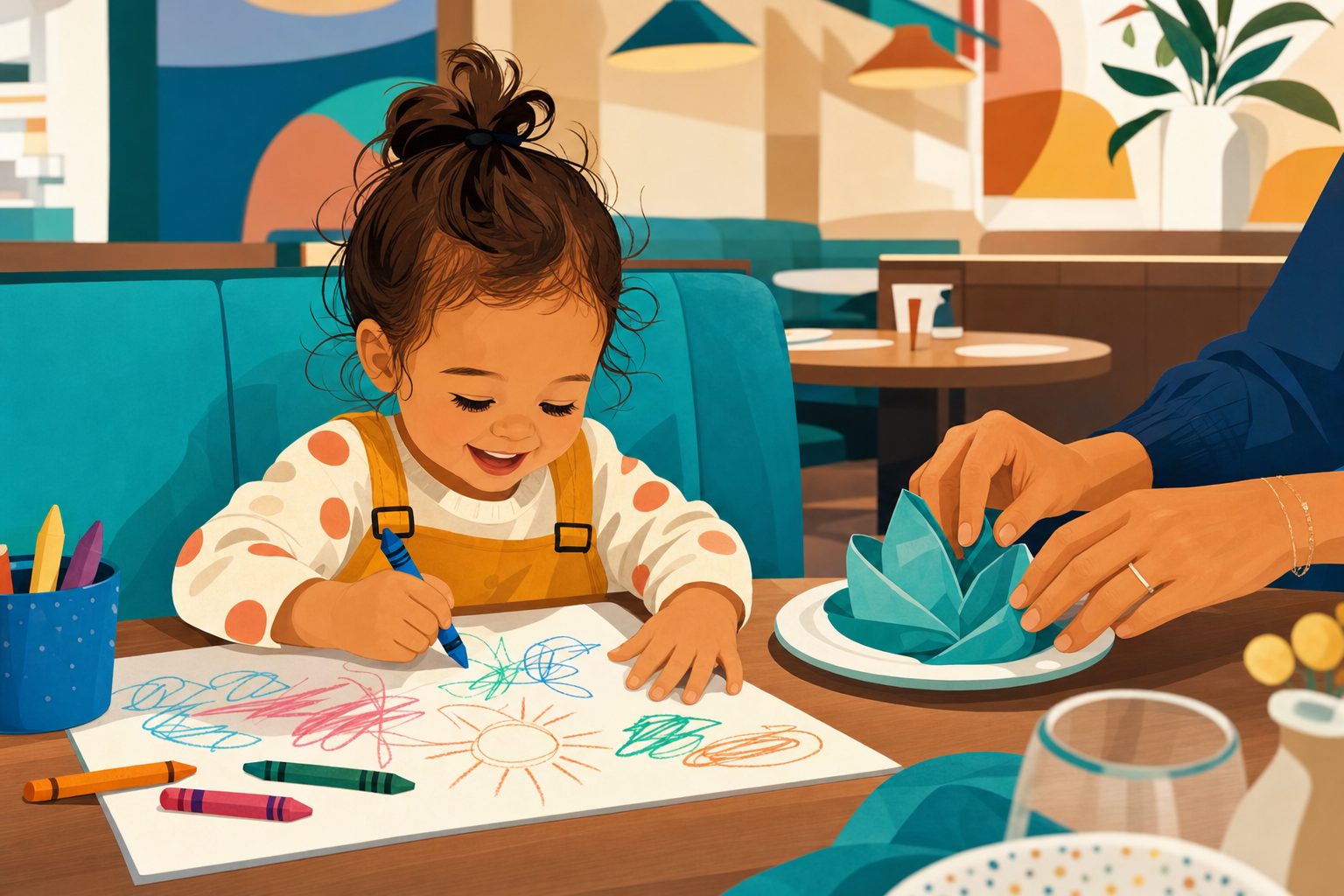
How to Keep a 2- to 6-Year-Old Busy at a Restaurant Without Screens, Toys, or a Meltdown
You're already seated, the menus are open, and your toddler is climbing the booth before the server even brings water. Restaurant outings with little kids can unravel fast, especially when you're caught without your usual backup plan (the tablet, a sticker book, or that one bendable dinosaur). The good news: you don't need a bag full of toys or a screen to survive the next 30 minutes. You just need a few quick, quiet activities that work with what's already on the table.
Use What's on the Table (Seriously)
Restaurant tables come pre-loaded with entertainment if you know where to look. Hand your 2-year-old a stack of sugar packets and let them sort by color or build a tiny tower. Older preschoolers can arrange the packets into patterns or count them out loud.
Napkins are surprisingly versatile. Fold one into a simple paper airplane, a boat, or a fan. A 4-year-old can try folding their own while you guide them. If there are straws (paper ones work best), show them how to tear tiny pieces of the wrapper and "race" them across the table by blowing gently.
Salt and pepper shakers double as instant props for a guessing game. Hide a small item (like a crumpled napkin ball) under one shaker, shuffle them around slowly, and let your child guess where it went. It's low-key, quiet, and keeps little hands busy.
Play Verbal Games That Don't Need Props
You don't need anything in your hands to keep a preschooler engaged. Try "I Spy" with items around the restaurant: "I spy something red," "I spy someone wearing a hat." Keep it simple for younger kids (colors, shapes) and add detail for older ones ("I spy something that starts with the letter B").
Another one: "What's Missing?" Place three small items on the table (a spoon, a napkin, a coaster). Let your child close their eyes while you remove one. When they open their eyes, they guess what's gone. Swap roles so they get a turn hiding something from you.
"Would You Rather" works well for 4- to 6-year-olds. Keep it silly and food-related: "Would you rather eat pizza for every meal or only eat ice cream?" "Would you rather have purple hair or green hair?" It's a conversation starter that doesn't require you to manage any materials.
Give Them a Job (They Love Helping)
Kids this age are wildly motivated by feeling useful. When the server brings the drinks, ask your 3-year-old to count how many cups are on the table. Let them be the "napkin distributor" and hand one to each person. If there's a bread basket, they can be in charge of offering it to everyone.
For older preschoolers, turn ordering into a task. Before the server comes back, ask them to remember one thing everyone ordered. When the food arrives, they get to announce, "That's Daddy's burger!" It's a memory game disguised as helpfulness.
If your child is fidgety and needs to move, send them on a low-key mission: "Can you count how many tables have flowers on them?" or "How many people are wearing blue?" They get to stand, look around, and report back. It burns a little energy without causing chaos.
Keep a Tiny Emergency Kit in Your Bag (Not a Full Busy Bag)
You don't need a dedicated busy bag for every restaurant trip, but three small items can save you when the wait drags on. Pack a tiny notepad and a pencil stub. A 2-year-old will scribble; a 5-year-old can draw the food they're waiting for or play tic-tac-toe with you.
A small stack of index cards or blank business cards fits in any purse. Use them for quick games: draw simple shapes and ask your child to copy them, write numbers for them to put in order, or make a mini matching game by drawing pairs of circles, stars, or hearts.
Pipe cleaners are quiet, bendable, and infinitely reusable. A preschooler can twist them into letters, shapes, or animals. They don't roll off the table, they don't make noise, and you can toss them back in your bag when you're done.
If you're looking for another reliable distraction, coloring is one surefire way to buy yourself ten quiet minutes. A quick free printable from Chunky Crayon and a few crayons can turn a wiggly toddler into a focused artist, no prep required.
When They're Done in Five Minutes (Because They Will Be)
Even the best activity won't last the full meal. When your child finishes their napkin tower or loses interest in "I Spy," rotate to something new immediately. Don't wait for the whining to start.
Switch from a hands-on activity to a conversation game. Ask them to tell you about their favorite part of the day, or what they'd do if they had a pet dragon. Let them ask you a question and give a silly answer. The goal is to keep their brain engaged, even if their hands aren't.
If they're squirmy, take a quick lap. Walk to the bathroom together (even if they don't need to go), check out the fish tank by the entrance, or step outside for 60 seconds to look at cars in the parking lot. A tiny break resets their patience and buys you another few minutes of calm when you sit back down.
For younger toddlers, sometimes the simplest reset is a snack from your bag. A few crackers or a pouch can bridge the gap between "I'm bored" and "the food is here." It's not a long-term solution, but it's a tactical one.
Age-Specific Tweaks for Restaurant Activities
For 2- to 3-year-olds: Keep it tactile and immediate. Sugar packet stacking, napkin tearing (into small pieces they can crumple), and simple verbal games like "Can you find something yellow?" work best. They need to touch things and move their hands. Avoid anything with too many steps or rules.
For 4- to 5-year-olds: They can handle slightly more complex tasks. Tic-tac-toe on a napkin, memory games with items on the table, and storytelling prompts ("Tell me about a dragon who loves pizza") keep them engaged longer. They also love being the helper, so lean into job-based activities.
For 6-year-olds: They're ready for real games. Play 20 Questions, make up rhyming challenges, or let them create a menu for an imaginary restaurant on a napkin. They can also entertain themselves a bit longer, so your job is more about checking in and asking questions than leading every activity.
What to Do If They're Already Melting Down
If you're reading this mid-meltdown, here's the short version: pick one thing from the list above and start immediately. Don't ask if they want to play, just begin. "Let's see who can fold this napkin into the smallest square" or "I'm thinking of something blue, can you guess?"
If the meltdown is noise-level serious, take them outside for two minutes. No lecture, no frustration, just a quick break. When you come back in, try a completely different activity than the one that failed. Sometimes a reset is all they need.
Restaurants are hard for little kids. They're asked to sit still, wait for food, and stay quiet in a stimulating environment. The activities that work best are the ones that feel like play, not discipline. When you frame it as "let's see how many forks are on our table" instead of "sit still and be quiet," cooperation goes way up.
The next time you're out to eat and realize you forgot the busy bag, you'll already have a plan. No screens, no meltdown, just a few quick ideas and whatever's already on the table.