October 12, 2026
Screen-Free Activities While You Work From Home
Stop kids interrupting while you work. Try these no-prep, low-supervision indoor activities for siblings ages 2 to 10. Get the free rotation plan now.
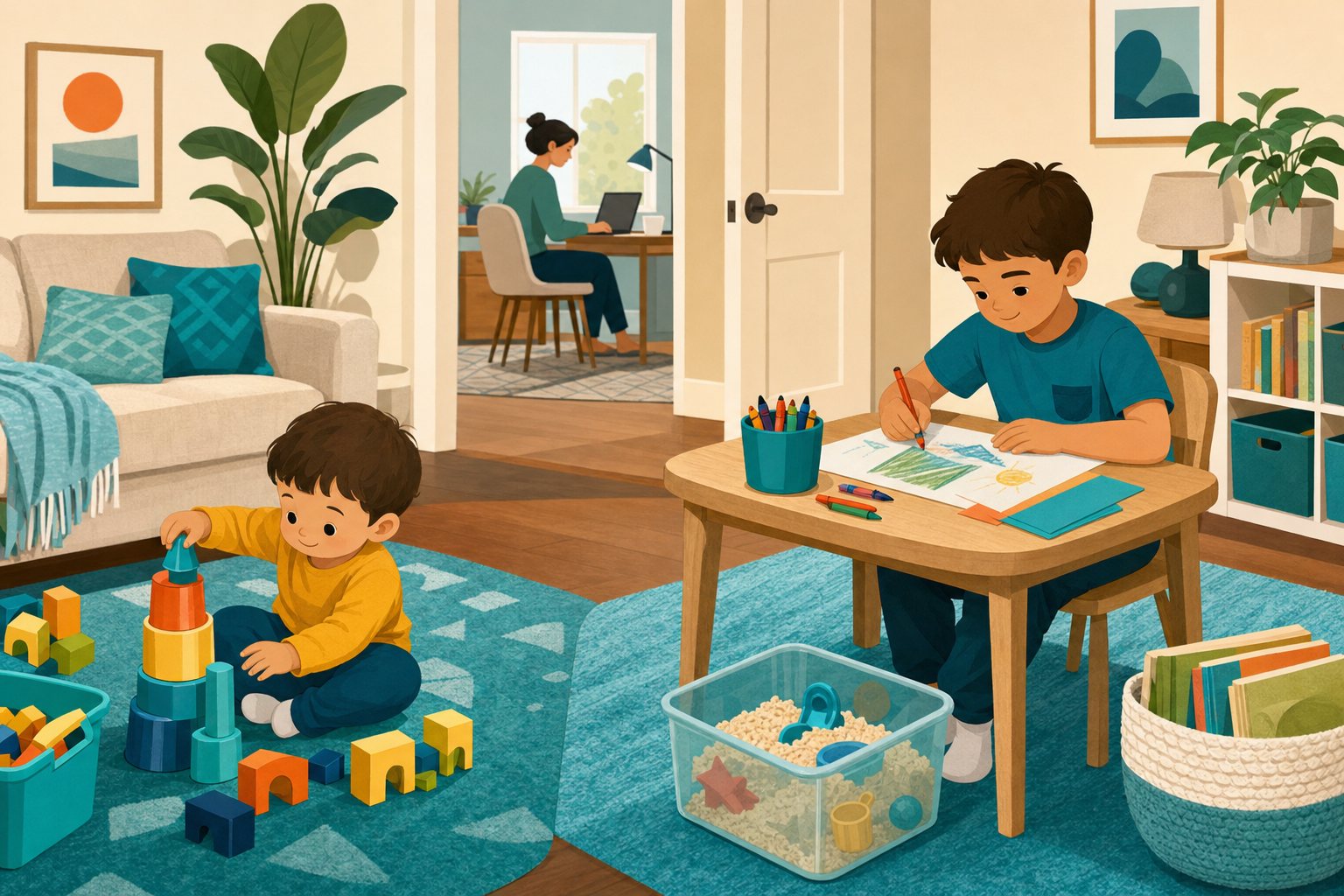
How to Keep Siblings Quietly Occupied Indoors While You Work From Home (Ages 2 to 10)
You're three minutes into a client call and someone is crying about a shared crayon. Again. If you work from home with kids in the house, you already know the problem isn't finding activities, it's finding activities that don't require you to referee every five minutes.
Most advice lists give you forty ideas for screen-free play and call it done. What they skip is the actual system: which activities work with zero supervision, which ones need a quick check-in, and how to keep a 2-year-old and a 9-year-old from destroying each other's setups in the same room. That's what this post fixes.
Sort Activities by Supervision Level, Not Age
The real variable that determines whether you get an uninterrupted hour isn't what the activity is, it's how much supervision it demands. Build your rotation around three tiers:
Zero-supervision (fully independent)
- Sticker books, sorting bins, magnet tiles
- Playdough with cookie cutters
- A "mystery bag" of random household objects to sort by color or size
Low-supervision (check in every 15 to 20 minutes)
- Building a blanket fort
- A simple scavenger hunt with a written or picture list
- Water painting on the sidewalk or in the bathtub (towels down first)
High-supervision (save for breaks between calls)
- Baking, cutting with scissors for the younger sibling
- Anything involving the stove, scissors near a toddler, or new craft supplies
When you're heading into a 45-minute meeting, only pull from the zero-supervision tier. Save the higher-touch stuff for your 10-minute gaps between calls, when you can actually glance over.
Build a Rotation, Not a Pile of Toys
Independent play while a parent works falls apart when kids have access to everything at once. Too many choices actually increases boredom and bickering, because nothing feels special and everything gets dumped on the floor within ten minutes.
Instead, rotate four to six activity bins weekly and only put one or two out at a time:
- Bin A: fine motor (lacing cards, stickers, playdough)
- Bin B: building (blocks, magnet tiles, cardboard box kit)
- Bin C: pretend play (dress-up, puppet theater, play kitchen)
- Bin D: sensory (dry rice bin, water beads, shaving cream on a tray)
Swap bins every few days. The novelty of "new" toys that were actually just hidden in a closet buys you way more quiet time than anything you'd buy online. This is the same logic behind a flexible weekend routine chart for kids who lose track of what's next: predictable structure with built-in variety keeps kids engaged without you managing every transition.
Give Each Sibling Their Own Job (Even the 2-Year-Old)
Mixed-age siblings fight most when they're forced to share one activity meant for one skill level. The fix isn't separating them into different rooms (hard to supervise from your desk anyway), it's giving each kid a parallel task they can do side by side without needing the same materials.
Try this split during a typical hour:
- Ages 2 to 3: Sensory bin, large-piece puzzle, or a basket of soft blocks
- Ages 4 to 6: Playdough with tools, simple scavenger hunt, dress-up with a "mission" (pretend to be a chef, a vet, a mail carrier)
- Ages 7 to 10: LEGO build challenge with a timer, a comic strip to draw, a simple recipe card to follow (no stove) like making trail mix
Same room, same general supervision window, different tasks. If you need more structure for this exact setup, this guide to screen-free indoor activities for siblings ages 2 to 10 breaks down pairings by age that actually hold attention.
Handle Interruptions Before They Happen
Kids interrupting while a parent works is rarely about needing something urgent. It's usually about needing to know you're still there. Headline off that need before your work block starts instead of reacting to it mid-sentence.
- Set a visual signal. A closed door, a sign, or a colored cup on your desk (green means "ask me anything," red means "wait for a break") gives kids a concrete rule instead of a vague "don't bother me."
- Pre-answer the top three questions. Before you log on, say out loud: "Snacks are on the counter, the timer will go off in 20 minutes, and if you need me for blood or fire, come find me." It sounds silly, but naming the exceptions reduces false alarms.
- Use a timer they can see. A visual timer (sand timer, or a phone propped up showing a countdown) tells kids exactly how long they need to hold it together without asking you every five minutes.
- Schedule a check-in, don't wait to be checked on. Pop out between meetings for 90 seconds, even just to say "doing great, five more minutes." It resets their patience clock.
For days when the fighting starts before the activities even get going, a focused reset like the 30-minute plan in siblings bored indoors and fighting can break the cycle fast, even mid-workday.
Keep a Low-Mess Backup for When Everything Else Fails
Every rotation needs one activity that's fast, contained, and doesn't need setup instructions, because some days nothing on the list works and you need a save right now. Coloring fills that role better than almost anything else: no batteries, no mess that needs real cleanup, and kids of very different ages can do it side by side without competing. A free Chunky Crayon page buys you ten to fifteen quiet minutes with zero prep, which is exactly what you need when a call runs long.
A Sample Work Block, Start to Finish
Here's what this looks like in practice during a 90-minute work window:
- 0 to 5 minutes: Set the visual signal, start the timer, pull two bins (one low-supervision, one zero-supervision).
- 5 to 30 minutes: Kids work independently. You're on your call, door signal is up.
- 30 to 35 minutes: Quick check-in between meetings. Swap one bin if interest is fading.
- 35 to 60 minutes: Second stretch of independent play, ideally the quieter of your two activities since attention is dipping.
- 60 to 90 minutes: If energy is crashing, this is your moment for the coloring backup or a short scavenger hunt to burn off wiggles before your next call.
The Bottom Line
You don't need more activity ideas, you need a system: sort by supervision level, rotate instead of dumping out everything at once, give each sibling their own parallel task, and handle interruptions before they start instead of after. Quiet activities for kids indoors work best when they're predictable, not when they're elaborate. Pick two or three pieces of this rotation to try tomorrow and see which one actually buys you the longest stretch of focus.