October 13, 2026
Screen-Free Sibling Activities for Ages 2 to 10 (30 Min)
Stop sibling fights with this 30-minute screen-free plan for mixed-age kids 2 to 10. Low-prep indoor activities that keep everyone happy, try it today.
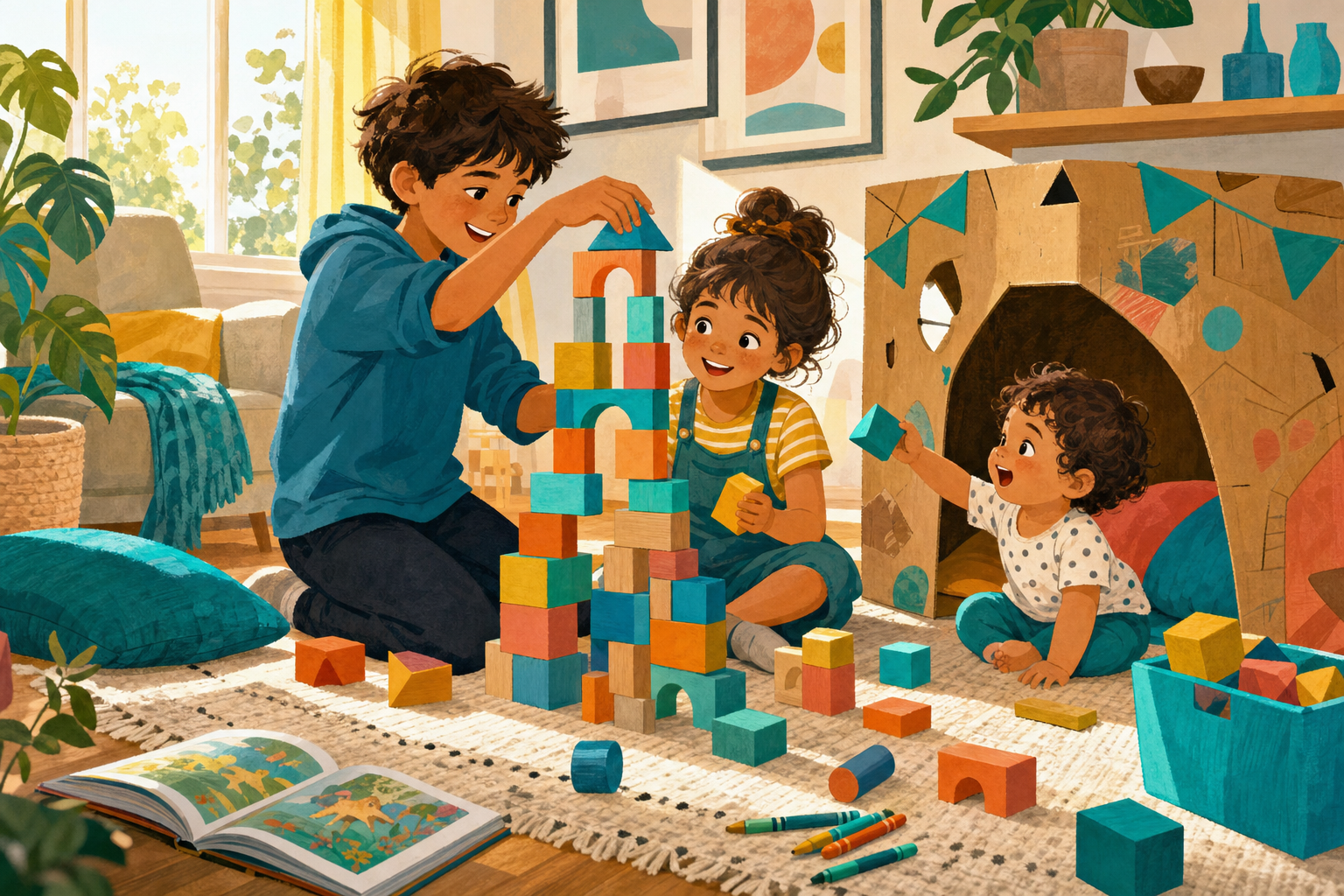
What Can Siblings of Different Ages Do Together Indoors Without Screens? A 30-Minute Activity Plan for Ages 2 to 10
Your 10-year-old wants Legos with 500 pieces. Your 2-year-old wants to eat the Legos. Within four minutes someone is crying and you're the referee again. This is the actual problem with most sibling activity lists: they give you an idea, not a plan for how a toddler and a fourth grader share it without one of them ruining it for the other.
Here's a 30-minute, three-phase plan that gives each kid a real job, keeps the age gap from blowing things up, and doesn't need any special supplies. This works as a reliable screen-free sibling activity for different ages because every phase has a built-in reason the big kid can't take over and the little kid can't wreck it.
Why Most Sibling Activities Fall Apart in 5 Minutes
The gap between a 2-year-old and a 10-year-old isn't just skill level, it's goals. The older kid wants to build something that works. The younger one wants to touch, dump, and move. Put them on the same task with no defined roles and you get one of two outcomes: the big kid takes over completely, or the toddler destroys the project and triggers a meltdown.
The fix isn't finding an activity they both naturally love. It's splitting one activity into roles that match what each age actually wants to do. That's the whole plan below.
The 30-Minute Plan: Three 10-Minute Phases
Phase 1 (Minutes 0 to 10): Sorting and Building, Separate Jobs
Pick one bin: blocks, dry pasta, measuring cups, laundry socks, anything with multiples. The older child's job is to build or arrange something specific (a tower, a sorted rainbow line, a pattern). The younger child's job is to fetch and hand over pieces one at a time from a separate pile.
- Give the toddler their own small container so they're not grabbing from the build itself.
- Tell the older kid out loud: "Your job is building. Their job is the supply truck." Naming the roles out loud cuts arguing by half.
- If the toddler wants to knock it down, that's allowed, just designate a demolition zone a few feet away so the main build is safe.
This phase works as a quiet activity for siblings indoors because both kids are seated and focused, not competing for the same object.
Phase 2 (Minutes 10 to 20): One Shared Prop, Different Roles
Switch to pretend play with a single prop: a laundry basket becomes a boat, a cardboard box becomes a store, a blanket over chairs becomes a cave. The older child runs the story (captain, shopkeeper, vet). The younger child gets a repeatable, physical job inside that story: passenger who loads cargo, customer who hands over pretend money, patient who gets bandaged.
- Give the toddler a prop that's theirs alone (a stuffed animal, a bag, a hat) so they don't need to fight over the main item.
- If the older kid starts bossing too much, redirect with a question, not a correction: "What's the passenger's next job?" This keeps them in charge of the game instead of in charge of the sibling.
- This phase doubles as rehearsal for cooperative play. If sharing control is a recurring fight in your house, a printable sticker chart for turn-taking can reinforce the habit outside of this 30 minutes too.
Phase 3 (Minutes 20 to 30): Independent Wind-Down, Same Room
This is the phase that actually lets you step back. Both kids work solo, side by side, no shared object required. The older child gets a slightly harder task they can do without help (a maze, a word search, finishing the earlier build). The younger child gets a repetitive, low-mess task: stacking cups, stickers on paper, or coloring.
This is also the exact moment to use that line every parent knows: