October 2, 2026
Stop Sibling Fights: No-Prep Indoor Activities for Ages 2-10
Discover a no-prep activity rotation for mixed-age siblings that reduces fighting and lets you work. Try it today for peaceful, screen-free playtime.
Why Generic Activity Lists Don't Work for Working Parents
You don't need 50 craft ideas. You need your 3-year-old and your 8-year-old to leave you alone for an hour without anyone crying.
Most lists of screen-free sibling activities at home assume you have time to set up a sensory bin, cut paper for a craft, or referee a board game. That's the gap. You're on a work call in ten minutes, and the only thing you have time to do is point at something and say "go do that."
This is a no-prep activities for siblings system, not a list. It uses stuff already in your house, it works across a 2 to 10 age spread, and it's built around the real reason mixed-age siblings fight when left alone: boredom hits at different speeds depending on age, so one kid wants to move on while the other is still deep in it.
The 3-Round Rotation That Actually Buys You an Hour
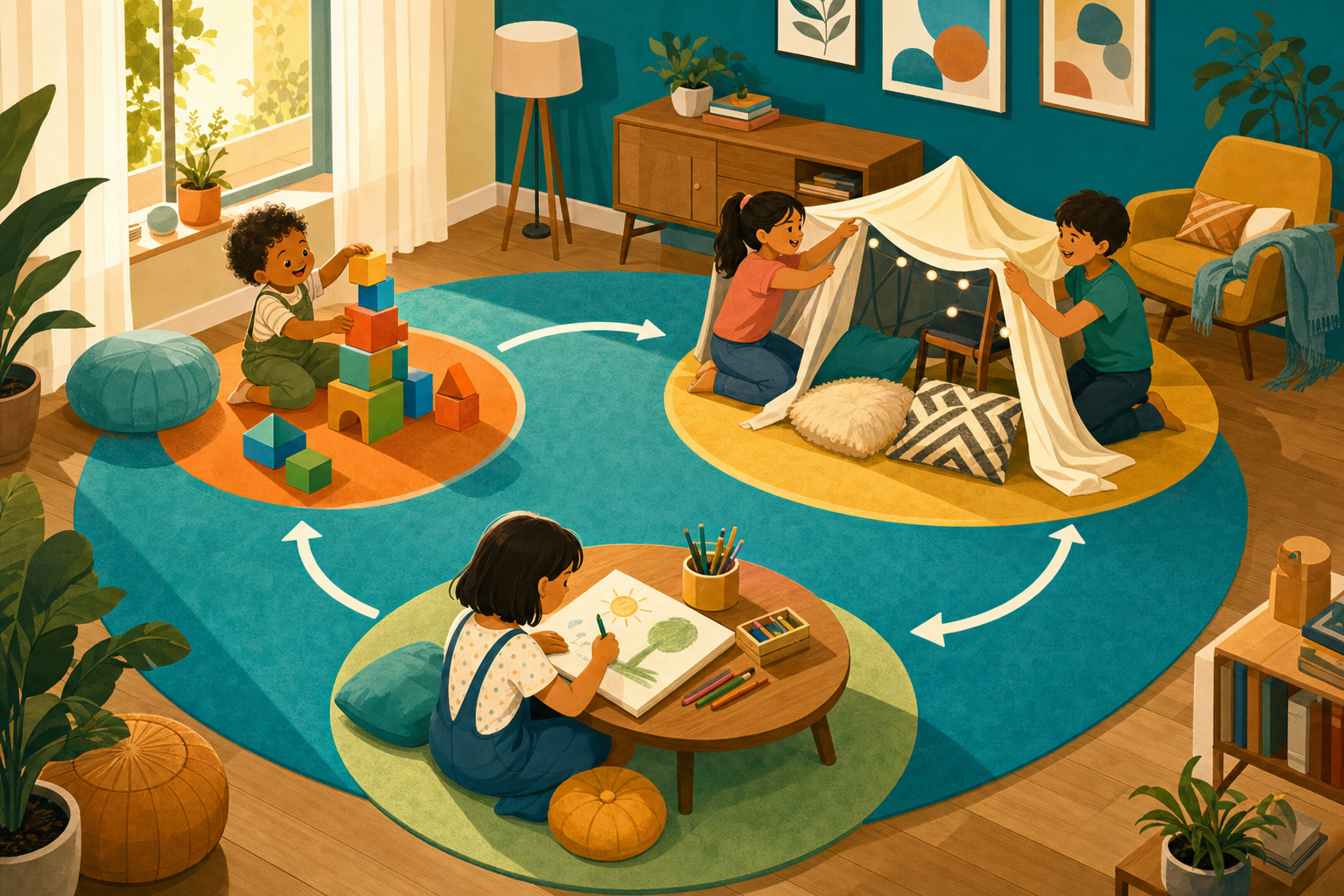
Instead of picking one activity and hoping it lasts, run three short rounds back to back. Each round is 15 to 20 minutes, which matches most kids' actual independent attention span better than a single "go play for an hour" instruction ever will.
The trick for mixed-age indoor activities is that every round has a job for the older kid and a job for the younger kid inside the same activity, so they're playing near each other instead of fighting over whose turn it is.
Set a timer each round. When it beeps, they move to the next station without asking you. That's the whole system.
Round 1: Builder (gross motor, loud, gets wiggles out)
Round 2: Quiet (low energy, buys you deep focus time)
Round 3: Mission (imaginative, gives the older kid ownership)
Round 1: The Builder Round
Pull every couch cushion, blanket, and dining chair you own into one pile in the living room. The job split:
- Older kid (6 to 10): "chief engineer" who designs the fort or obstacle course
- Younger kid (2 to 5): "delivery crew" who hands over pillows and blankets one at a time
This works because the older kid gets a role with actual authority (something that genuinely reduces sibling fighting) and the younger one gets constant motion, which is what toddlers need more than complexity.
No supplies to buy. No setup beyond what's already in the room. If you've got a tape measure or painter's tape, an obstacle course around furniture works the same way: one kid designs the path, one kid tests it.
Round 2: The Quiet Round
After 15 minutes of fort chaos, energy needs to drop or round 3 turns into wrestling. This is your deep-focus window, the 15 to 20 minutes where you actually get work done.
Give each kid their own quiet task at the same table, side by side but not shared, which prevents the "you're touching my stuff" fights that ruin shared activities for siblings of different ages:
- A notebook and pencil for the older kid to write or draw a comic
- A muffin tin with dried pasta, buttons, or pom-poms for the younger kid to sort by color
- A deck of cards for solo games like solitaire or building a card tower
Coloring is one of the most reliable options here too. Keep a stack of pages ready, or pull up a free coloring page from Chunky Crayon on a tablet and print it, so there's always a fresh one instead of the same three pages from the bottom of a drawer.
If this is happening on a rainy afternoon and you need more rainy day activities for siblings beyond this one rotation, we've put together a full list of no-prep indoor activities for siblings that slot into this same quiet round.
Round 3: The Mission Round
Last stretch before you need to fully check out. Give them a "mission" with a concrete finish line, because open-ended "go play together" instructions are exactly when fights start.
Examples that work from toddler to tween:
- Scavenger hunt: write (or have the older kid write) five clues for items hidden around one room
- Restaurant: older kid is chef, younger kid is customer who orders from a drawn-up "menu"
- Spy mission: find ten things in the house that are a specific color
Giving the older sibling a defined leadership role (chef, clue-writer, mission commander) is the single biggest factor in whether this stays peaceful. Kids ages 8 to 10 want ownership, not babysitting duty, and framing it as their mission to run keeps them invested instead of resentful. For more structured, independent play for that age specifically, our post on screen-free sibling activities has extra mission-style ideas that scale up for older kids.
Setting Up the Rotation So Kids Run It Themselves
The whole point of a rotation is that you set it once and don't referee it live. Before you sit down to work:
- Say the three rounds out loud once: "Fort, then quiet table, then mission."
- Set a visible timer (phone or kitchen timer) they can see without you.
- Tell them the rule before round 1 starts: no interrupting you unless someone is hurt or bleeding.
- Post a simple written or picture list of the three rounds somewhere they can check it themselves.
That last point matters more than it sounds. Kids under 7 interrupt constantly not because they're trying to annoy you, but because they haven't built the habit of checking a plan before checking with you. If interrupting is a chronic issue in your house beyond just this hour, the strategies in our guide on kids who interrupt pair well with this rotation.
What to Do When the Fighting Starts Anyway
It will, sometimes. Two realistic fixes that don't require you to stop working:
- Swap roles, not activities. If they're fighting over who's "in charge," call out from your desk, "Switch jobs!" and let the engineer become the delivery crew for round 1, or the chef become the customer for round 3.
- Shrink the round. If a 20-minute round is too long for independent play while a parent works, cut it to 10 minutes per round and run the rotation twice. Shorter, successful rounds beat one long round that ends in a meltdown.
This isn't about finding the perfect activity. It's about giving mixed-age siblings a structure with clear roles and a visible endpoint, so quiet indoor play for two kids (or three, or four) doesn't depend on you being in the room.
Start with one round today. If it buys you even 15 real minutes, add the next round tomorrow.