October 9, 2026
Siblings Bored Indoors and Fighting? Try This 30-Min Reset
Kids fighting because bored indoors? Try this screen-free 30-minute reset with low-prep sibling games for ages 4 to 10. Get the activity list now.
What to Do When Siblings Are Bored Indoors and Keep Fighting: A 30-Minute Reset
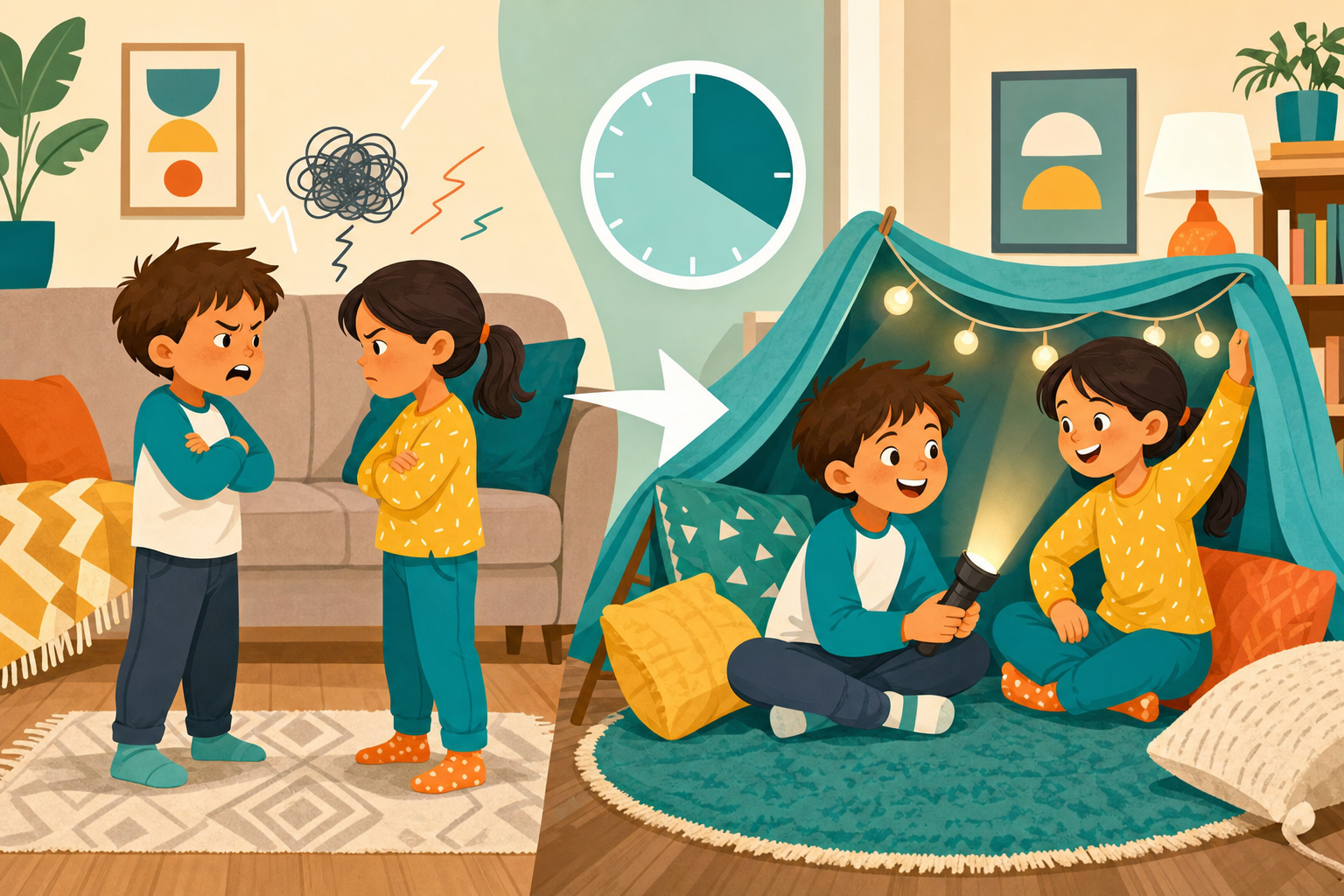
It's 4pm, it's raining, and your kids have gone from "I'm bored" to full-on yelling in under ten minutes. You know the fighting isn't really about the toy or the remote. It's about too much unstructured time and not enough to do. Siblings bored indoors with no screens allowed will find something to fight about, every single time.
The good news: you don't need a Pinterest-worthy craft station or an hour of your undivided attention. You need a short, structured reset that gets them out of conflict mode and into play mode, fast. Here's a 30-minute system that works for siblings ages 4 to 10, even when they're years apart developmentally.
Why Siblings Fight More When They're Bored
Kids fighting because they're bored indoors isn't random. Boredom removes the thing that usually keeps siblings from clashing: a shared goal. Without one, they default to competing for your attention, a toy, or control of the TV remote.
The fix isn't more toys. It's a quick activity with a clear structure that gives each kid a job and removes the need to negotiate from scratch. That's what separates a real reset from just handing them a bin of Legos and hoping for the best.
The 3-Phase, 30-Minute Reset
Think of this as a mini schedule, not a single activity. It works because it moves kids through three different modes so nobody gets stuck in one frustrating phase too long.
Phase 1: Separate and Reset (5 minutes)
Before you introduce anything new, split them up for five minutes. This isn't punishment, it's a circuit breaker. Give each kid one tiny, low-effort task in a different room or corner:
- Count how many red things are in the kitchen
- Find five items that start with the letter B
- Build the tallest possible stack of books
No partner needed, no rules to argue about. This alone defuses most of the tension before you even get to the main activity.
Phase 2: Shared Challenge (15 minutes)
This is the core of the reset: one low-prep sibling game ages 4 to 10 can both play, but with different roles so nobody feels babysat or bored. A few that consistently work:
- Sock basketball with handicaps. Younger sibling shoots from close range into a laundry basket, older sibling shoots from across the room or has to shoot with their non-dominant hand. Everyone has a real chance to win.
- Blanket fort inspection. One kid builds, one kid is the "inspector" who has to find three structural weaknesses. Swap roles halfway through.
- Freeze dance judge. One kid dances, one kid is the judge holding up a score on their fingers. Rotate every round so both get stage time and power.
- Indoor scavenger hunt with a twist. Instead of a list, give one vague clue at a time ("something softer than a shoe") so the older kid can't just sprint ahead and win instantly; it rewards thinking, not speed.
The key move here is giving each child a distinct role (builder/inspector, dancer/judge) instead of making them do the identical task side by side, which is where most sibling activities fall apart. If you want a deeper bench of these paired-role games sorted by age gap, this list of screen-free sibling activities for ages 2 to 10 is worth bookmarking for next time.
Phase 3: Wind Down Solo (10 minutes)
After 15 minutes of shared play, energy and patience both start to dip. Rather than push through until someone snaps, transition to independent sibling play ideas where each kid does their own thing within eyesight of each other, not together.
- One kid gets a coloring page, one gets a puzzle
- One builds with blocks, one looks at a picture book
- One does a simple coloring activity (a free, printable Chunky Crayon page is an easy, no-prep option that buys you ten genuinely quiet minutes) while the other does quiet building
This phase matters because it lets the shared-play high note end before it curdles into bickering, which is exactly when most sibling fights actually start.
Indoor Sibling Activities Without Crafts (For the Days You Have Zero Setup Energy)
Some days you don't have glue sticks, paper, or the patience to clean up glitter. These indoor sibling activities without crafts need nothing but what's already in the house:
- Sock sorting race. Dump a basket of mismatched socks, time how fast they can pair them up together. Oddly satisfying and over in five minutes.
- Living room bowling. Empty water bottles as pins, a soft ball. One sets up, one bowls, swap.
- "Would you rather" battle. Take turns making up increasingly ridiculous would-you-rather questions. Zero materials, works great in a car line or waiting room too.
- Pillow fort radio show. Kids build a tiny fort, grab a flashlight, and take turns "broadcasting" a made-up news report or weather forecast.
For more rainy day activities for siblings of different ages that don't require you to pull out a single bin of supplies, this roundup of 12 screen-free indoor activities for siblings covers age-gap pairings specifically.
When the Age Gap Is the Real Problem
If your 4-year-old and your 9-year-old can't agree on anything, the fix usually isn't finding one perfect activity. It's giving them different jobs within the same game, like the builder/inspector or dancer/judge pairings above. The older kid gets to feel capable and in charge of something real, and the younger kid doesn't feel like they're just tagging along.
If transitions in general are a sore spot (not just sibling fights, but the shift from "free time" to "next thing"), a first-then visual chart can take the arguing out of the moment you announce it's time to stop one activity and move to the next.
Keep This on Standby, Not Just for Emergencies
The real win here isn't finding one magic activity, it's having a repeatable 3-phase structure you can reach for any time siblings bored indoors turns into a fight. Separate, share, then go solo. It takes 30 minutes, needs almost no supplies, and it gives both kids a real role instead of making them compete for the same one.
Next time the yelling starts and you need an idea on the spot rather than a whole system, spin the Boredom Wheel for an instant screen-free activity suggestion you can start in under a minute, no prep, no scrolling through ten tabs of ideas while two kids argue in the background.