June 21, 2026
Busy Bag Ideas for Shower Time: Screen-Free Solo Play
Discover no-prep busy bag ideas that keep 3 to 7 year olds safely entertained with independent play while you shower. Screen-free activities ready in under 2 minutes.
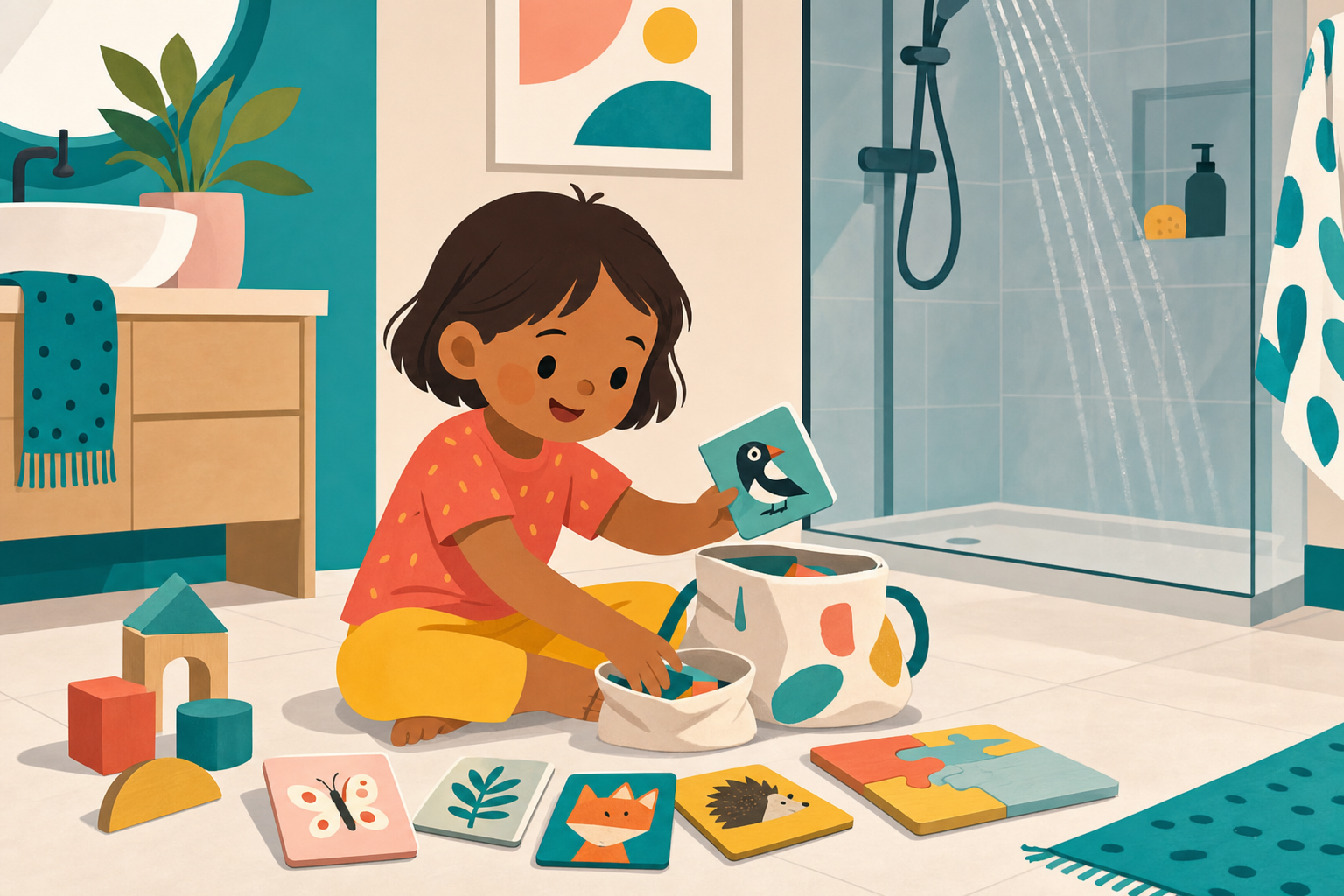
How to Keep a 3- to 7-Year-Old Busy While You Shower Without Screens, Mess, or a Big Prep List
You need ten minutes. Ten uninterrupted minutes to wash your hair, rinse the conditioner, and maybe shave one leg. But your preschooler is already at the bathroom door asking for a snack, a toy, or "just one more thing." You know screens work, but you don't want to hand over the tablet every single morning. You need a better plan.
The trick is not finding activities that occupy your child for an hour. It's finding quick quiet activities for kids at home that feel special enough to hold their attention for the exact window you need. Here's how to set up safe independent play ideas for young kids while you shower, with zero mess and almost no prep.
Why Shower Time Is So Hard for Independent Play
Your child doesn't actually need you while you shower. They need to know where you are, that you're coming back, and that they're not missing anything exciting. The bathroom door creates anxiety, not boredom.
That's why no-prep indoor activities for 3-year-olds work better when they happen in or near the bathroom. Your child can hear the water running. They know you're ten feet away. The activity doesn't have to be amazing, it just has to feel close and safe.
Set up a small play zone right outside the bathroom door or in a connected bedroom. Visual contact isn't necessary, but auditory reassurance is. Call out every minute or two: "I'm washing my hair!" or "Almost done!" This keeps the interruptions down and the independence up.
The Busy Bag for Shower Time (Set It Up Once, Use It Daily)
A busy bag for shower time is a dedicated container (a tote, a basket, or even a gallon Ziploc) filled with items your child only sees during your shower. The novelty is the whole point.
Here's what goes in it:
- A small photo album with family pictures (real printed photos, not a phone)
- Three to five small toys that rotate weekly (a toy car, a plastic dinosaur, a small doll)
- A stack of sturdy board books or picture books
- A set of large plastic links or a simple shape-sorter
- A small stuffed animal they don't usually play with
The bag lives on a high shelf. Your child doesn't dig through it or choose what's inside. You hand it over right before you step into the shower, and you take it back when you're done. The time limit makes it special. The rotation keeps it interesting.
This is one of the most reliable screen-free solo play ideas for preschoolers because it removes choice fatigue. Your child isn't deciding what to do; they're exploring what you gave them.
Activities That Work Right Outside the Bathroom Door
If you don't want to prep a busy bag, you can set up a single-focus activity in under sixty seconds. These work best for kids who need a clear task, not just a pile of toys.
Coloring station: Tape a single coloring page to the floor or a low table, set out two crayons, and walk away. Coloring is one reliable boredom-buster, and a free printable buys you ten quiet minutes. Limiting the crayon choices prevents decision paralysis.
Stuffed animal lineup: Ask your child to gather every stuffed animal in their room and line them up by size, color, or type. This is how to entertain kids for 10 minutes with zero supplies. The task feels important, and the sorting keeps their hands busy.
Puzzle on repeat: Leave out a single 12- to 24-piece puzzle your child has done a hundred times. Mastery feels good. They'll do it twice, maybe three times, and you'll be dry and dressed by then.
Audio-only entertainment: If your child can work a simple speaker or audio player, put on a five-minute kids' podcast episode or a single story. They stay in one spot, they're entertained, and you're not handing them a screen. This works especially well for 5- to 7-year-olds who can follow a story without visuals.
What to Do If Your Child Interrupts Anyway
Some kids will knock on the door no matter what you set up. They're not being difficult, they're just wired to check in. Here's how to respond without getting out of the shower:
Establish a one-question rule: Before you step into the shower, tell your child they get one question. That's it. No follow-ups. This reduces the door-knocking from twelve interruptions to one.
Use a visual timer: Set a kitchen timer or a sand timer where your child can see it. When the timer goes off, you'll be done. This works better than saying "ten minutes," which means nothing to a 4-year-old. A timer they can watch gives them control over the wait.
Reward the behavior you want: After a successful solo-play shower session, acknowledge it immediately. "You played by yourself the whole time! That was so helpful." If your child responds well to visual rewards, a simple sticker chart for morning routines can reinforce independent play without bribes. One sticker per successful shower session, five stickers earns a small privilege (picking the dinner vegetable, choosing the bedtime book).
How to Scale This as Your Child Gets Older
A 3-year-old needs you close and visible. A 7-year-old can handle independent play in another room entirely. Adjust your approach as your child's independence grows.
For 3- to 4-year-olds, keep the play zone right outside the bathroom. Use simple, closed-ended activities (a shape-sorter, a short stack of books). Expect interruptions, but reward the stretches of quiet.
For 5- to 6-year-olds, move the play zone to their bedroom or a nearby hallway. Introduce slightly longer activities (a 24-piece puzzle, a short audio story, a simple building task with blocks). At this age, they can handle "I'll be out in ten minutes" without constant reassurance.
For 7-year-olds, offer a short list of independent activities they can choose from (read in your room, draw at the kitchen table, build with Legos). They don't need a busy bag anymore; they need permission to entertain themselves and a clear expectation that you're unavailable for ten minutes.
The Bigger Picture: Teaching Kids to Wait
Shower time is one of the first places kids learn that adults have needs too. You're not ignoring your child; you're modeling that ten minutes of personal care is non-negotiable. That's a healthy boundary, not a parenting failure.
If your child struggles with other transitions (like leaving the house or cleaning up after meals), the same principles apply. Clear expectations, simple routines, and a little novelty go a long way. You might find that keeping kids busy while you clean the house uses the exact same strategies: a defined task, a short window, and a reason to stay independent.
The goal is not perfect silence. The goal is a child who can occupy themselves for ten minutes without a screen, without a mess, and without you solving their boredom every thirty seconds. That's independent play while parent showers, and it's a skill that gets easier with practice.
When to Spin the Wheel Instead
Some mornings, your child will reject every single option you offer. The busy bag is boring. The puzzle is too easy. The stuffed animals are stupid. When that happens, don't negotiate. Open Boredom Wheel on your phone, let your child spin, and hand them whatever activity it lands on. The randomness removes the power struggle, and the novelty buys you just enough time to finish your shower.
You'll be out in ten minutes. They'll survive. And tomorrow, you'll try again.