October 10, 2026
Siblings Bored Indoors? No-Prep Activities for Ages 2-10
Stop sibling fights fast with screen-free, no-prep indoor activities for ages 2 to 10. Try quiet games, independent play ideas, and rainy-day fun today.
What to Do When Siblings Are Bored Indoors and Keep Fighting: A No-Prep, Screen-Free Activity Plan for Ages 2 to 10
It's raining, it's day three of a school break, and your kids have gone from "I'm bored" to full-on shin-kicking in under twenty minutes. You don't need another list of 50 craft ideas you'll never have supplies for. You need a plan you can start right now, with zero prep, that actually fits a 2-year-old and a 10-year-old in the same room.
Here's the thing most advice gets wrong: it treats boredom like a creativity problem. It's not. It's an energy and structure problem. Siblings fight when they're understimulated, undirected, and competing for the same five toys. Fix the structure, and the fighting drops fast.
Why Siblings Fight More When They're Bored Indoors
Boredom doesn't feel neutral to a kid. It feels like static, and poking a sibling is the fastest way to make static go away. Add close quarters, no outdoor space to burn off energy, and an age gap where one kid wants Legos and the other wants to eat the Legos, and conflict is almost guaranteed.
The fix isn't more toys. It's giving each kid a clear role and a time limit. Vague, open-ended "go play together" instructions are where most indoor afternoons fall apart.
The 3-Step No-Prep Reset (Start Here)
When things are already heating up, skip straight to this. No supply list required.
Step 1: Separate for 5 minutes.
Physically split the kids into different rooms or corners, even if it's just one at the table and one on the couch. This isn't a punishment, it's a reset. Give each kid one simple instruction: "Find three things in this room that are the color blue" works for almost any age.
Step 2: Give each kid a "job," not a toy.
Kids under about 6 do better with a role than a task. Instead of "go play blocks," try:
- The Architect (builds something out of couch cushions, pillows, or blocks)
- The Reporter (has to describe what the Architect is building, out loud, like a sportscaster)
- The Inspector (checks the finished build and gives it a rating out of 10)
Swap roles every 7 to 10 minutes. The novelty of switching jobs does more to prevent fighting than any single toy ever will.
Step 3: Reunite with a shared, low-stakes goal.
After the separate time, bring them back together for something with a clear end point, like building the tallest possible cup tower before it falls. A defined finish line keeps things from sprawling into bickering over "whose turn it is forever."
For a deeper breakdown of this exact reset with timing cues, our post on a 30-minute reset for siblings who are bored and fighting walks through it minute by minute.
No-Prep, Screen-Free Activities That Work for Mixed Ages
These need nothing you don't already own. Each one flexes for a 2-year-old and a 10-year-old doing it side by side, not identically, but together.
- Sock basketball. Roll up socks, use a laundry basket or trash can as the hoop. Little kids throw from close up, older kids get a line to shoot from. Score keeping gives the older one a job.
- Freeze dance, no music needed. Someone hums or claps a rhythm and stops randomly. Works for toddlers through tweens, and the "caller" role rotates so the oldest isn't bored running it every time.
- Indoor scavenger hunt by category. "Find something soft, something round, something that starts with B." Give the older kid harder categories (something older than the house) and the younger one easier ones (something red).
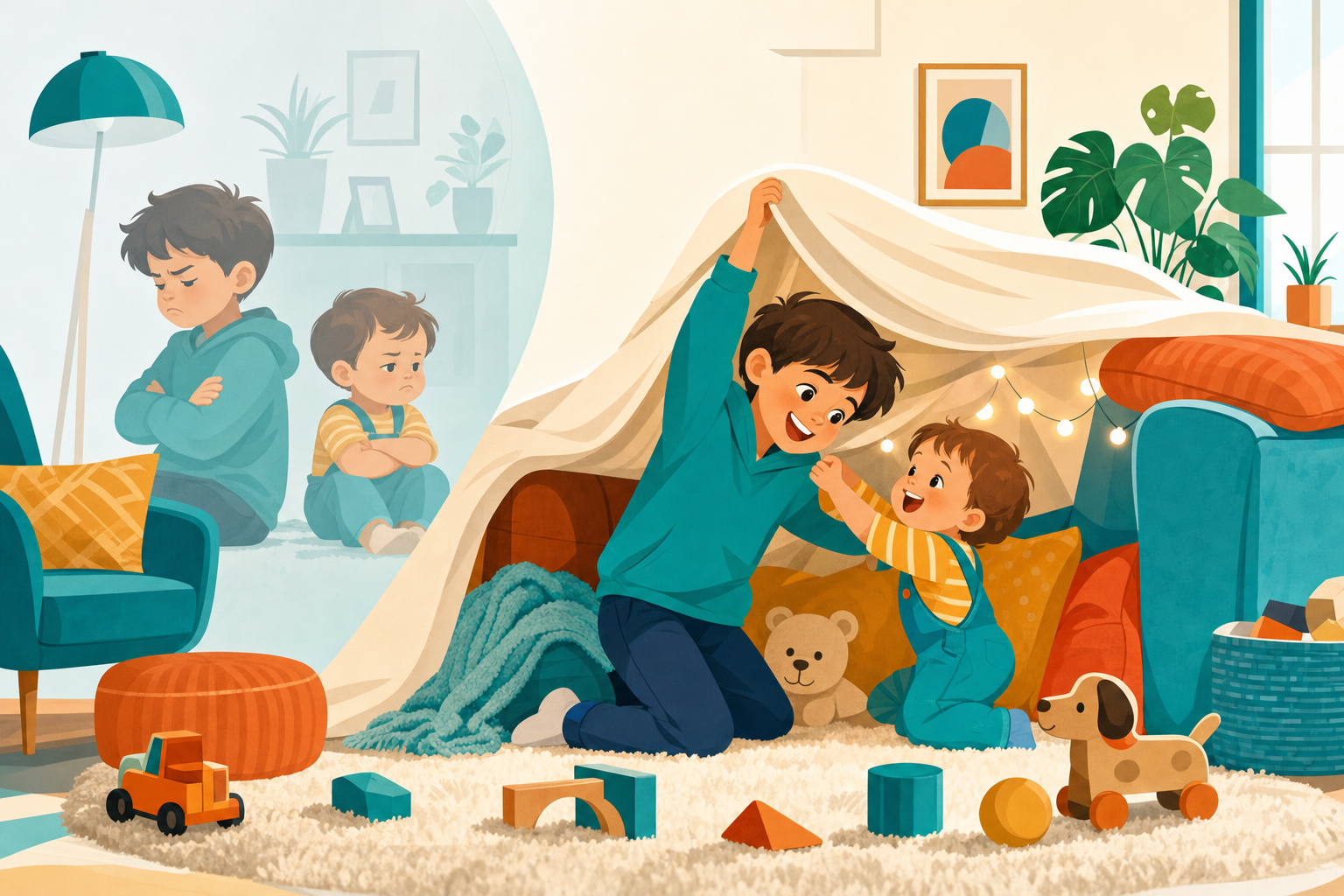
- Pillow fort inspection agency. One builds, one inspects for "structural safety," roles swap. This is pure independent play dressed up as teamwork, which keeps mixed-age siblings from needing identical skill levels.
- The quiet game with a twist. Whoever stays silent longest wins, but add a job: the youngest has to count on fingers how long it lasts. Everyone has something to do, nobody needs to talk.
For more options sorted specifically by age gap, see 12 screen-free indoor activities for siblings ages 2 to 10, which breaks activities down by which sibling does which part.
Independent Play for Mixed-Age Siblings (So You Get a Break Too)
Sometimes the goal isn't togetherness, it's just getting ten uninterrupted minutes. Parallel play, where kids are near each other doing different things, often prevents fighting better than forced sharing does.
Try:
- A "quiet corner" for the older kid with a book, a notebook for doodling, or a simple coloring page. Coloring is a reliable boredom buster on its own, and a free printable coloring page from Chunky Crayon can buy you ten genuinely quiet minutes while the younger one naps or plays nearby.
- A sensory bin (dry rice, pasta, scoops, cups) for the toddler or preschooler, set up on a towel so cleanup is a two-minute shake-out.
- A "mission" card for the oldest, like building something specific out of whatever's in the recycling bin, that takes 15+ minutes solo.
If turn-taking is the actual trigger for most of your fights (one toy, one chair, one favorite spot), a visual tool helps more than another verbal reminder. Our sticker chart for teaching toddlers to take turns gives younger kids a concrete way to see whose turn is next without a parent refereeing every round.
Quiet Indoor Games When You Need Noise Levels Down
Some days the issue isn't fighting, it's volume, especially during nap time, a work call, or a headache day. These keep siblings engaged without raising the roof:
- Whisper tag. Tag, but every "you're it" has to be whispered.
- Silent charades. No talking allowed at all, just acting out animals or chores.
- Staring contest tournament. Bracket style, works shockingly well across a wide age range and takes almost no setup.
- Flashlight shadow puppets. Even a 2-year-old can make a blob shadow and be thrilled about it.
When the Fighting Keeps Coming Back
If the same flashpoint shows up every single afternoon (always over the same toy, always right before dinner), that's a pattern worth solving directly instead of resetting every day. Rotating toys weekly, building in a predictable solo-time block, or using role assignments as a standing house rule (not just an emergency measure) all reduce how often you need the reset at all.
The goal isn't zero conflict. Siblings will always bump heads sometimes. The goal is giving bored, cooped-up kids something to do with their hands and their turn-taking frustration before it turns into a wrestling match on the living room floor. Start with the 3-step reset next time things start to simmer, and keep a rotation of two or three no-prep activities in your back pocket so you're never starting from zero.