October 19, 2026
Keep Kids Busy While You Work From Home (Ages 3-10)
No-prep, screen-free activities that buy parents 30 quiet minutes. Try this low-noise indoor rotation for ages 3 to 10 and reclaim your workday.
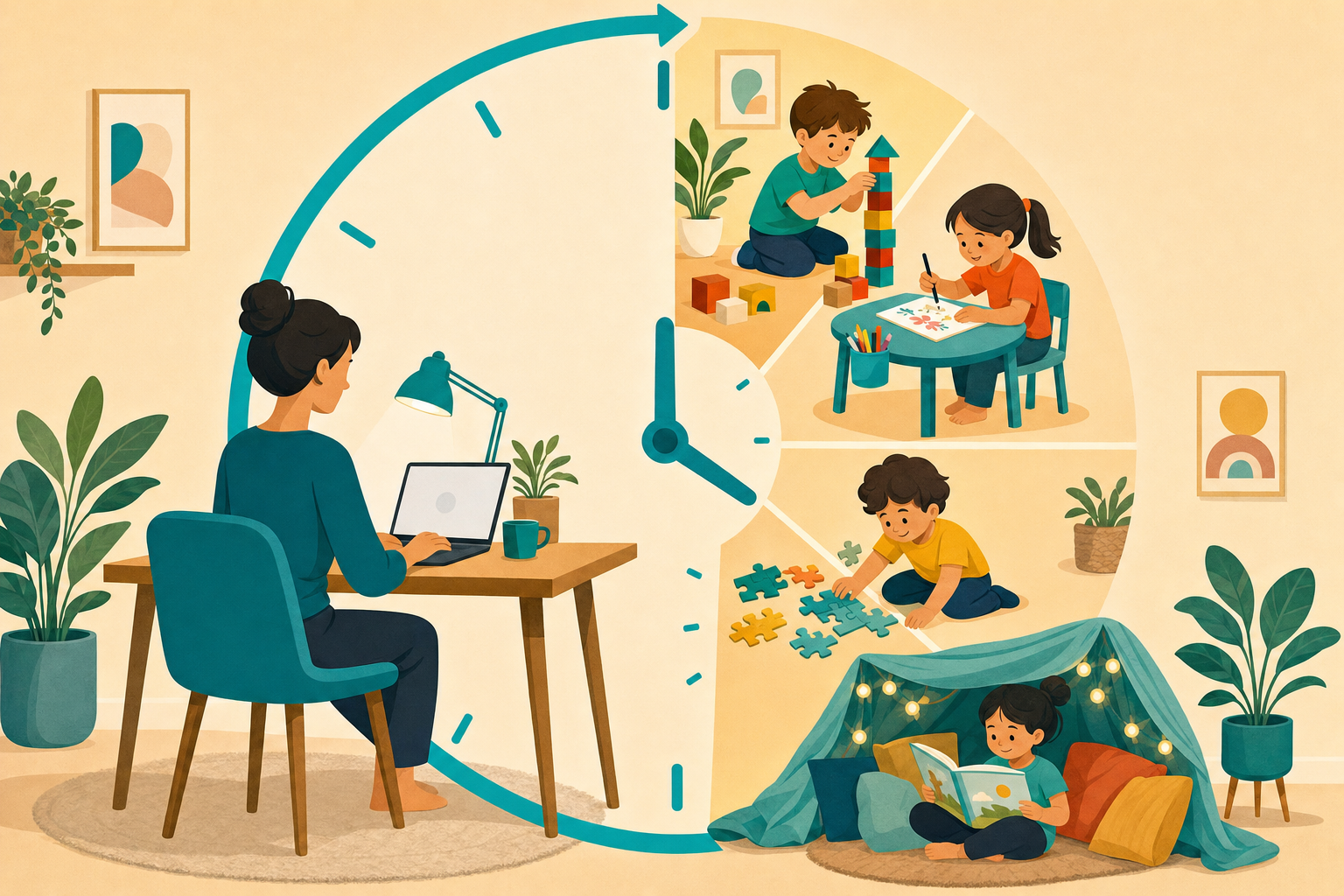
How to Keep Kids Busy While You Work From Home: A 30-Minute Screen-Free Rotation (Ages 3 to 10)
Your calendar says "focus block" but your living room says otherwise. You've got a call in five minutes and a kid standing in your doorway asking what there is to do. Generic lists of 40 activities don't help when you need something that works right now, lasts the length of a real meeting, and doesn't require you to referee every five minutes.
This is a rotation, not a list. It's built to run on autopilot once you set it up, with low-noise indoor activities ages 3-10 can handle without you hovering.
Why a Rotation Beats One Big Activity
One activity, even a good one, usually burns out around the 10-minute mark for younger kids. A rotation stretches attention because the change itself is the reward. Kids don't get bored of "doing things," they get bored of doing the same thing.
The trick is to pre-decide the order so there's zero negotiation mid-call. You're not asking "what do you want to do now?" You're pointing at a card, a bin, or a timer and saying "next."
This matters most if you're trying to buy a specific chunk of time, like a 30-minute meeting. Our full guide to keeping kids busy while you work from home covers the bigger picture setup if you need a longer-term system beyond one block.
The 30-Minute Rotation, Station by Station
Think of this as four 7 to 8 minute stations. No prep means no gathering supplies when you're already stressed, so keep these in a basket near your desk, ready to grab.
Minutes 0-7: Quiet hands task
Something repetitive and tactile. Dry beans and a muffin tin for sorting by color. Playdough with a rolling pin and cookie cutters. Lacing cards or pipe cleaners and beads. This is a no-noise activity that keeps little hands occupied while their brain settles.
Minutes 7-15: Paper and color
A coloring page, a blank notebook for "drawing a map of the house," or a sticker scene. Coloring is one reliable boredom-buster, and a free Chunky Crayon page buys you ten quiet minutes without you printing anything from your own stash.
Minutes 15-22: Pretend play or building
Blocks, a cardboard box fort, stuffed animals set up for a "doctor visit," or a sock puppet show rehearsal. This stage is naturally the loudest of the four, so put it in the middle where a little noise won't wreck your call.
Minutes 22-30: Scavenger hunt or treasure search
Write five simple clues on index cards the night before ("find something soft," "find something that starts with B"). This one is independent rainy day activities gold because it moves kids through the house without needing you, and it naturally winds down energy right before you reappear.
Laminate or just keep four index cards with pictures of each station taped to the fridge. Point, don't explain.
Age-by-Age Tweaks
The rotation works across ages 3 to 10, but the version looks different depending on who's using it.
Ages 3-5: Shorten each station to 5 minutes and skip anything with small parts if you're not in the room. Beans and muffin tins become big pom-poms and a spoon. Keep a grown-up check-in built in, like a one-minute "show me" between calls.
Ages 6-8: This age group can genuinely run all four stations solo. Add a simple written checklist they can check off themselves, which also sneaks in reading practice.
Ages 9-10: Stretch each station to 10 minutes and let them choose the order. At this age, the goal shifts from entertainment to real independent play, like a chapter of a book, a drawing project, or building something from a kit.
If you've got more than one kid, pair them at different stations instead of the same one. Two siblings sorting beans together turns into a fight over who has more beans. Two siblings at different stations rarely cross paths long enough to argue. For more on managing mixed ages without a referee, our guide to screen-free indoor activities kids can play independently breaks down pairing strategies by age gap.
Setting the Rules Before You Disappear
The rotation only works if the ground rules are set before you sit down at your desk, not shouted from behind a closed door mid-call.
- Show them the visual schedule. Point to each card and say the order out loud once.
- Set a visible timer. A kitchen timer or a phone propped up works. Kids this age don't track time well, so let the timer do the nagging instead of you.
- Define "interrupt-worthy." Blood, fire, or someone stuck. Everything else waits for the next break. Say this plainly: "If it's not one of those three things, you can tell me when I'm done."
- Pick a signal for "I'm free." A specific song, a closed laptop, or stepping out of the room. Consistency here matters more than the signal itself.
If your household already runs on a routine chart for other parts of the day, this rotation slots in easily next to it. Families using a flexible weekend routine chart often just add the four work-block stations as one more row.
When It Falls Apart Mid-Call
Sometimes a kid walks in at minute 12 anyway. Don't troubleshoot live on camera. Mute, point silently to the next station card, and hold up fingers for how many minutes are left. This takes four seconds and doesn't require you to leave the call.
Keep one "emergency" station in your back pocket that's more engaging than the regular four, saved only for when things are genuinely unraveling. A special sticker book, a never-before-seen toy, or a surprise snack works because novelty buys more focus than familiarity. Rotate what's in the emergency slot every week or two so it doesn't lose its power.
If you're consistently getting interrupted at the same point in your schedule, that's useful data. Move your hardest calls to the station that tends to hold attention longest, usually the paper-and-color block or the scavenger hunt.
Make It Routine, Not a One-Time Fix
The real win isn't one good 30 minutes, it's the fifth or sixth time you run this and your kid walks to the first station without being told. That takes about a week of consistent repetition at the same time each day.
Keep the basket stocked, keep the cards in the same spot, and resist the urge to redesign it every few days. Predictability is what makes activities that buy parents 30 minutes actually work long-term, not the cleverness of any single idea.