October 14, 2026
Keep Kids Busy While You Work From Home: Quiet Play Ideas
Screen-free, no-prep activities to keep kids ages 2 to 10 quietly busy during work calls. Try this simple 30-minute play rotation today.
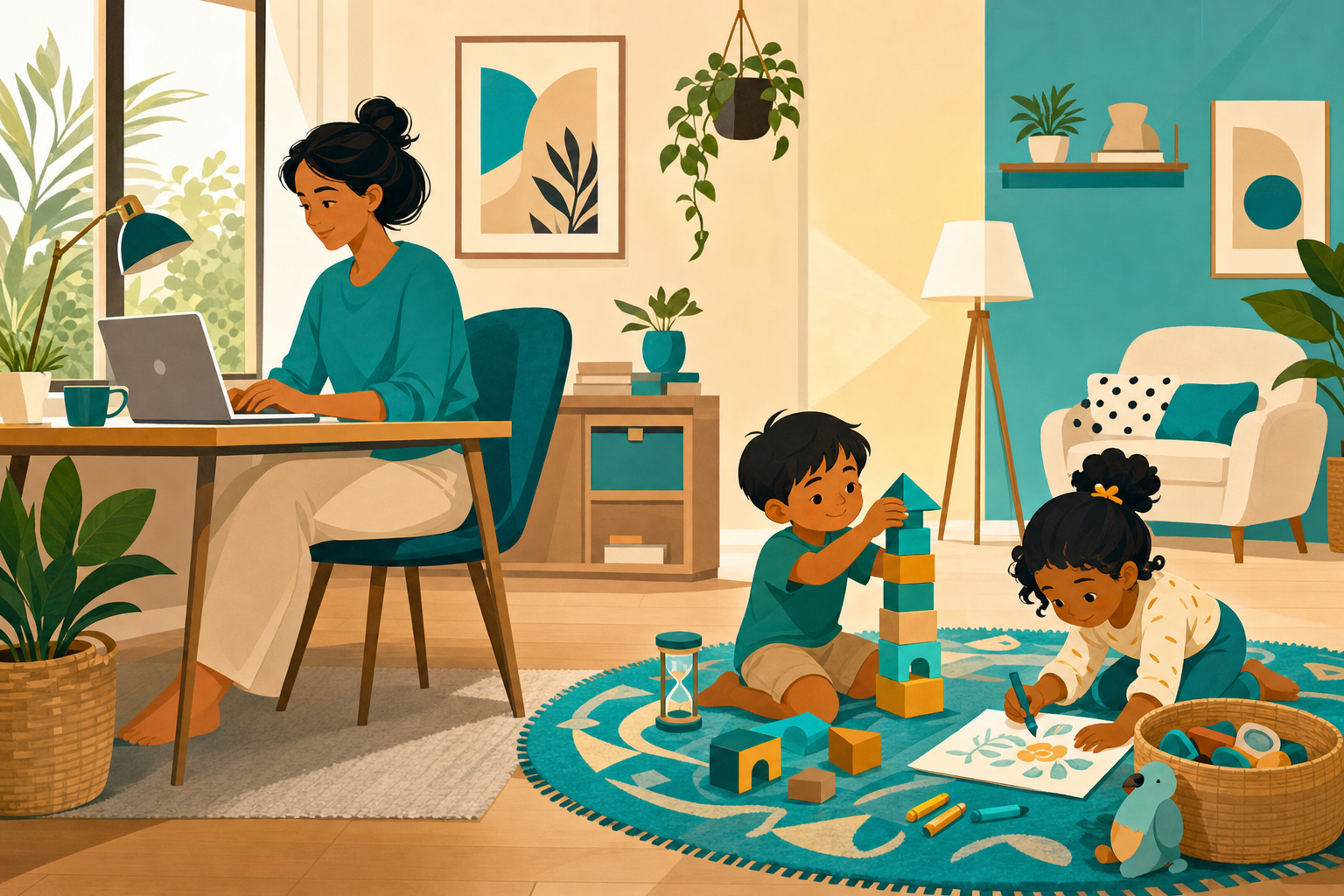
How to Keep Kids Busy While You Work From Home: A Quiet, 30-Minute Activity Rotation (Ages 2-10)
Your calendar says 9:00 call, 9:45 call, 10:30 call, and your kid is standing in the doorway holding a sock like it's an emergency. You don't need 50 activity ideas. You need a system that buys you predictable blocks of quiet, independent play, matched to how old your kid actually is.
That's what this is: a rotation you can set up once and reuse every work day, not a scroll of random crafts.
Why Most Activity Lists Don't Work for a Work-From-Home Day
Most "keep kids busy" lists are built for a rainy Saturday, not a Tuesday with back-to-back calls. They suggest sensory bins, scavenger hunts, and craft projects that need setup, supervision, or cleanup you don't have time for right now.
What you actually need during a 30-minute call is:
- Something low-mess enough that you're not scrubbing marker off the wall at 10:31
- Something quiet enough that it doesn't bleed into your audio
- Something matched to your kid's age, because what occupies a 9-year-old for 30 minutes will bore a 3-year-old in four
- Something that doesn't need you to referee, demonstrate, or problem-solve mid-call
The fix isn't more ideas. It's a rotation: three or four go-to activities per age group that you repeat, so your kid already knows the rules and doesn't need you to explain anything.
Build Your Rotation by Age, Not by Activity Type
Here's the core idea: pick one activity from each bucket below and set it up as a "station" your child can return to without you. Rotate stations daily so nothing gets stale, but keep the format the same.
Ages 2-3: 10 to 15 minute attention span, needs physical containment
- A laundry basket "nest" with 5 to 6 familiar toys they haven't seen since yesterday (rotate the same 15 toys in and out, it works like new every time)
- A muffin tin with dry pasta or pom-poms and a spoon for scooping and sorting
- Painter's tape "roads" on the floor for toy cars, no supplies needed
Realistically, a 2 or 3-year-old can't carry a full 30 minutes alone. Plan for 10 to 15 solid minutes, then a 2-minute check-in where you say one sentence and go back to your call.
Ages 4-5: 15 to 25 minutes, loves a "job"
- A clipboard with paper and a pretend "checklist" (count red things in the room, draw every family member)
- A box of stickers and envelopes to fill and "mail"
- A quiet coloring page. This is genuinely one of the most reliable options at this age: a free printable coloring page from Chunky Crayon gives them something fresh to focus on without you prepping anything.
Ages 6-7: 20 to 30 minutes, can follow multi-step instructions
- A "mystery mission" written on a card: find 7 things that are blue, hide them in a bag, no talking allowed until the timer ends
- Dot-to-dot or maze books
- Quiet building challenge: "build the tallest tower with only these 12 blocks"
Ages 8-10: Full 30 minutes, can self-direct
- A chapter book with a sticky note marking a stopping point
- A notebook for a "secret comic" or journal entry
- A simple craft kit they assemble solo (origami, friendship bracelets, a puzzle)
If you have more than one kid, pairing them by activity type instead of age usually causes less friction than you'd expect. There's a full breakdown in screen-free sibling activities for ages 2 to 10 if you're managing multiple kids during the same call block.
Set Up the Rotation the Night Before (It Takes 5 Minutes)
The whole system falls apart if you're assembling activity bins while your 9:00 call is already ringing. Do this the night before, or during nap time:
- Pick 3 to 4 stations for the next day based on your call schedule
- Put each one in its own small bin or basket, labeled with a sticky note if you have multiple kids
- Line them up somewhere your kid can see them, like a shelf or the kitchen counter
- Tell your kid at breakfast: "Today's stations are the pasta scoop, the sticker envelopes, and the block tower. Pick one when I go on my call."
That 60-second conversation at breakfast does more work than any single toy. Kids this age do better with a known plan than with being handed something cold mid-meeting.
Use a Visual Timer, Not a Verbal One
Telling a 4-year-old "I'll be done in 30 minutes" means nothing to them. A visual timer (the kind that shows a shrinking red section) gives them something to watch instead of something to ask about. Put it where they can see it, not where you can see it.
For kids who get anxious about when exactly you'll be back, a simple routine chart style approach helps more than a timer alone. If your child tends to lose interest in a plan after a day or two, the reset strategies in this 7-day sticker chart reset apply just as well to an activity rotation chart as they do to a reward chart.
What to Do When the Rotation Breaks Down Mid-Call
Even a good system has off days. A few quick fixes that don't require you to leave your desk:
- Keep a "emergency reserve" bin that only comes out during calls, never on weekends. Novelty alone buys 10 extra minutes.
- Use a one-word signal (a sticky note on your door that says "wait" vs. "ok") so kids old enough to read can self-check without knocking.
- If a sibling fight breaks out, a pre-agreed separation spot (one kid at the table, one on the rug) prevents a 2-minute interruption from turning into a 10-minute one. More on splitting siblings by age and energy level in routine charts for siblings with different ages.
If a full meltdown happens, it's okay to mute, say one calm sentence, and get back on the call. You're not failing the system, you're just hitting its limit for that day.
Keep It Boring on Purpose
The instinct is to make each station exciting and new. Resist that. The whole point of a rotation is predictability: the same bins, the same stations, reused for weeks. Predictable is what lets a kid play without you, because they already know what to do and don't need to ask.
Swap one station every few days, not all of them. One new thing keeps it fresh without blowing up the whole system the week you need it most.
For more structured ideas broken out by what's already in your house, screen-free activities while you work from home has a longer supply-based list you can pull from when you're building your next rotation.