June 1, 2026
Laundromat Activities for Kids: 15 No-Prep Boredom Busters
Discover 15 creative screen-free activities to keep your 3 to 6 year old happily entertained at the laundromat. No toys needed, zero meltdowns guaranteed!
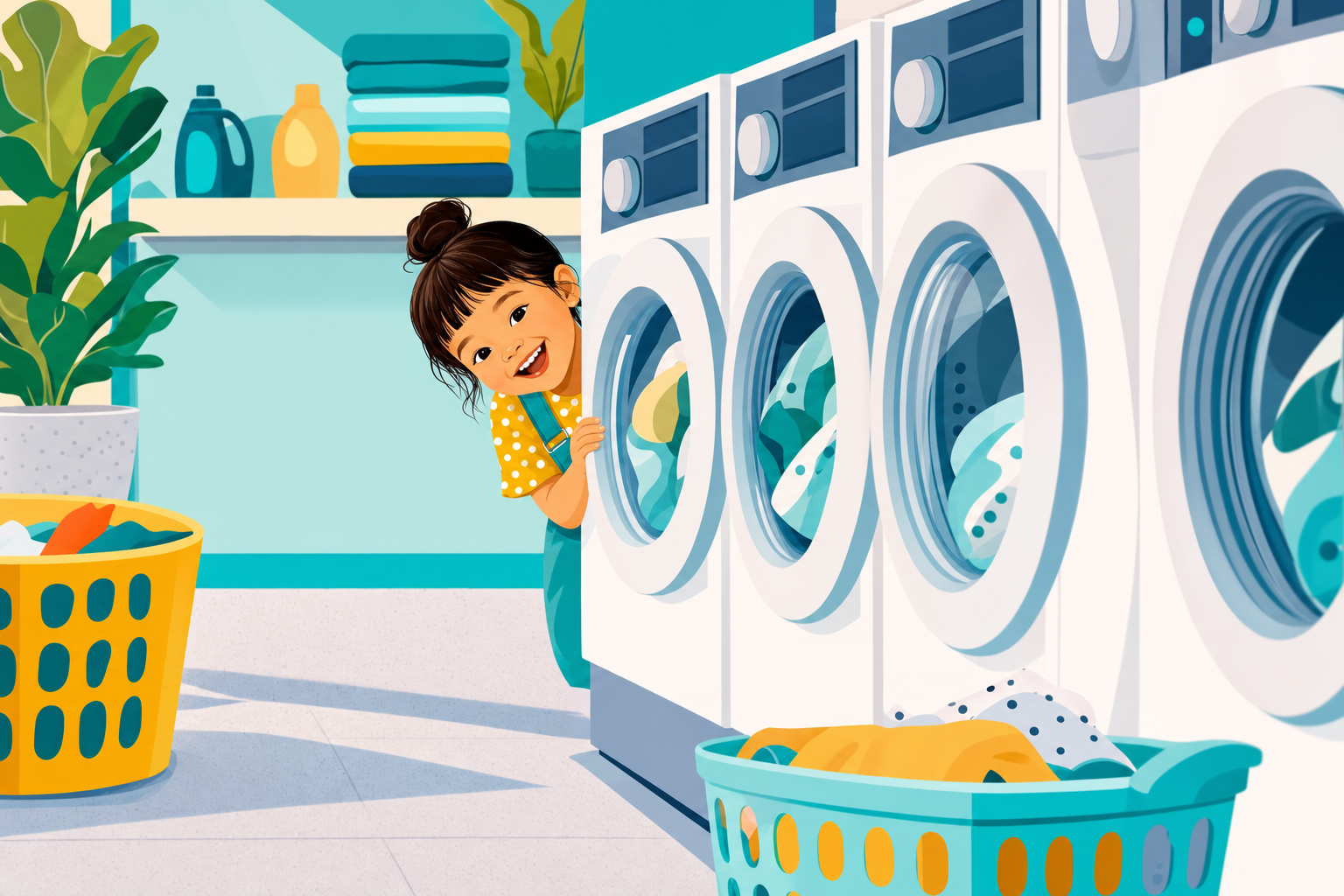
How to Keep a 3- to 6-Year-Old Busy in a Laundromat (No Screens, No Meltdown)
You're halfway through a double load when your preschooler starts spinning in circles, whining "I'm bored," and eyeing the coin change machine like it's a toy. Laundromat visits with young kids can turn tense fast. You need them occupied, you can't leave, and you definitely can't hand over a phone for 45 minutes of uninterrupted Peppa Pig.
Here's how to keep a 3- to 6-year-old entertained at the laundromat without screens, without hauling a toy store, and without losing your mind.
Why Laundromats Are Uniquely Hard for Little Kids
Laundromats hit a perfect storm of boredom triggers. The space is unfamiliar, there's nothing kid-friendly to do, the machines are loud but not interesting for long, and you're stuck there until the spin cycle ends. Unlike a waiting room with toys or a car ride with scenery, laundromats offer almost nothing for a young brain to latch onto.
Add in the fact that you're juggling detergent, quarters, and wet towels, and you don't have two free hands to entertain a restless preschooler. You need laundromat activities for kids that are self-directed, compact, and ideally reusable for next week's trip.
Pack a Tiny Laundry Day Kit (Five Items Max)
You don't need a full busy bag. You need five portable things that buy you ten-minute chunks of focus. Here's what actually works for screen-free waiting room activities for kids in tight spaces:
A small notebook and a crayon. Let them draw laundry machines, make scribble monsters, or fold the paper into "letters" for stuffed animals at home. If they're into coloring, a free Chunky Crayon page tucked in your bag buys you quiet minutes while you sort socks.
A deck of cards. Three-year-olds can stack them, sort by color, or play "find the red one." Five-year-olds can play Go Fish or War. Cards take up zero space and survive a washing machine incident.
A small bag of pipe cleaners. Bend them into letters, shapes, bracelets, or glasses. Kids can twist them around chair legs, their own fingers, or each other. Pipe cleaners are quiet, cheap, and nearly indestructible.
A tiny figurine or two. One dinosaur, one Paw Patrol pup, one random Happy Meal toy. That's it. Let them walk the toy across folding tables, hide it in laundry baskets, or narrate a whole adventure between the washer and the vending machine.
A snack in a container they have to open themselves. Raisins in a Tupperware, Cheerios in a Ziploc, crackers in a reusable pouch. The opening and closing buys you three extra minutes of focus. For laundry day activities for toddlers, fine motor work doubles as entertainment.
Don't pack more than this. You're hauling laundry. Keep it minimal.
Give Them a Laundromat-Specific Job
Kids this age love feeling useful, and laundromats offer weirdly satisfying tasks. Assign one small job and let them own it. Here are no-prep activities for 3 year olds that double as genuine help:
Sock matching. Dump clean socks in a pile and let them find pairs. Three-year-olds can match by color. Five-year-olds can match by size or pattern. It's a real task, it keeps their hands busy, and you actually need it done.
Counting quarters. If you trust them not to lose coins, let them count out quarters for the next load. Older preschoolers can stack them, sort them, or hand them to you one at a time. It's sneaky math practice.
Laundry basket captain. Put them in charge of one empty basket. They guard it, drag it to the folding table, or stack folded towels inside. The sense of ownership keeps them engaged longer than you'd expect.
Button pusher. Let them press the start button on the dryer (with supervision). It's a one-second task, but the anticipation of waiting for you to say "okay, now!" keeps them hovering nearby instead of wandering.
For more ideas on keeping kids engaged during必要 waits, check out these waiting room activities for toddlers and preschoolers that translate well to laundromats.
Teach Them One New Quiet Game Per Visit
Laundromats are boring for kids because there's nothing novel. Fix that by teaching one simple game each time you go. It gives them something to anticipate and keeps your routine from feeling repetitive. These quiet activities for kids in public require zero supplies:
I Spy (laundromat edition). "I spy something spinning." "I spy something blue." Keep it concrete for younger kids. Older preschoolers can handle "I spy something someone is wearing."
Counting games. Count how many washers are running. Count red shirts in the dryer window. Count how many people come in before your load finishes. Preschoolers love concrete counting tasks.
Freeze dance (silent version). Whisper a song together and have them freeze when you stop. No music needed. It burns energy in a 3x3 space without bothering anyone.
Would you rather? "Would you rather fold towels or socks?" "Would you rather wash stuffed animals or shoes?" Keep it laundry-themed and silly. Kids this age will debate the socks vs. towels question for five solid minutes.
Story chain. You start: "Once there was a sock that got lost in the dryer." They add one sentence. You add another. Keep it going until the washer beeps. It's independent play ideas for preschoolers that's actually collaborative, which helps when you're stuck in one spot together.
Let Them Move (Just a Little)
Three- to six-year-olds aren't built to sit still for 40 minutes. If the laundromat isn't packed, let them move in controlled ways. Here's how to burn energy without causing chaos:
Laundry basket rides. Sit them in an empty basket and push them two feet across the floor. One ride, then back to waiting. It's enough movement to reset their brain.
Wall sits or chair sits. Challenge them to sit against the wall with their legs bent (like a chair) for ten seconds. Older preschoolers will try to beat their own record. It's weirdly tiring and keeps them in one spot.
Tiptoe walks. Have them walk on tiptoes from your chair to the vending machine and back. Make it a spy mission or a balance challenge. It's quiet, controlled, and uses up wiggles.
Stretching. Teach them one stretch (reach for the ceiling, touch your toes, butterfly legs). Let them show you three times while you fold. It's calming and burns a little energy.
These work well alongside the movement breaks you'd use during rainy day activities at home, adapted for tighter spaces.
Use the Machines as the Entertainment
Washers and dryers are honestly fascinating to preschoolers if you frame them right. Instead of fighting the environment, lean into it. Point out what's happening and let them narrate:
Watch one item. Pick a bright towel or a favorite shirt. Have them watch it spin and count how many times they see it go around. It's messy, imperfect counting, but it holds attention.
Guess the sound. Close your eyes together and guess which machine is making which sound. Is that the washer filling or the dryer tumbling? Kids love being right.
Predict the timer. Guess together how many minutes are left. Let them check the timer and see if they were close. Older preschoolers love being the timekeeper.
Sort by category. While you fold, have them sort clothes into piles: pants, shirts, socks, or towels. It's a real task that doubles as a learning game.
What to Do When Nothing Is Working
Some days, your kid is just done. They're tired, they're overstimulated by the noise, or they're hitting that late-afternoon witching hour when everything is hard. Here's your backup plan:
Sit them on your lap. Sometimes they just need closeness. Let them lean against you while you fold. It's not entertaining, but it's stabilizing.
Narrate what you're doing. Talk through your process out loud. "I'm folding this towel in half, then in half again." It's boring for you, but soothing for them. Your voice is familiar in an unfamiliar space.
Give them one thing to hold. A clean towel, a sock, a dryer sheet. Let them scrunch it, fold it, or just hold it. Tactile input helps.
Call it early if you can. If they're truly melting down and you've got one load left, consider finishing at home. Not every laundromat trip needs to be a win. Sometimes survival is enough.
For more strategies on handling late-day meltdowns, check out these 5-minute boredom busters for witching hour, which translate well to public meltdowns.
Make Laundry Day Predictable
Kids handle boring tasks better when they know what to expect. If laundromat trips are a weekly thing, build a mini routine:
Same day, same time. Saturday mornings or Wednesday after preschool. Predictability reduces resistance.
Same snack. Pack the same snack every time. It becomes part of the ritual, and rituals feel safe.
Same job. Give them the same task each visit (sock matcher, quarter counter, basket captain). They'll get better at it and feel competent.
Same reward. After laundry, you always stop for a bagel, or you always go to the playground, or you always read two books at home. Knowing what comes next helps them tolerate the boring part.
You don't need a formal sticker chart for laundry day cooperation, but if your child responds well to visual rewards, check out sticker charts vs reward charts to see what might fit your family.
The Real Goal: Teach Them to Wait
Laundromats are boring, but boring isn't bad. Learning to wait without a screen, without constant input, without entertainment handed to them is a skill. You're not just keeping them busy. You're teaching them that boredom is survivable, that waiting is part of life, and that they can handle it.
Some visits will be smooth. Some will be a struggle. Both are normal. Pack your five-item kit, give them a job, teach them one game, and let the machines do some of the work. You'll get through it, the laundry will get done, and next week you'll try again.
And if all else fails, there's always sock matching. Kids never get tired of finding the missing pairs.