May 28, 2026
57 Waiting Room Activities for Kids Ages 2 to 6 (No Screens!)
Discover quiet, no-prep activities to keep toddlers and preschoolers busy in waiting rooms without screens, toys, or meltdowns. Perfect for doctor visits!
How to Keep a 2- to 6-Year-Old Busy in a Waiting Room Without Screens, Toys, or a Meltdown
You've been sitting in the doctor's office for 23 minutes, your toddler is eyeing the toy basket another family brought, and your preschooler just asked "Is it our turn yet?" for the ninth time. You left the house in a rush, your bag has receipts and expired coupons but zero entertainment, and screen time feels like cheating (or you forgot to charge the tablet). Here's how to pull off waiting room magic with nothing but what's already around you.
The Fundamental Strategy: Narrate, Count, Categorize
Waiting room activities for toddlers don't need props. They need a job. Give your child something specific to notice, count, or sort, and their brain switches from "I'm bored" mode to "I'm on a mission" mode.
Try these no-prep standbys:
- Color hunt: "Find five red things in this room. Go."
- Pattern detective: "Which pictures on the wall have circles? Which ones have squares?"
- People watch (quietly): "How many people are wearing sneakers? How many have glasses?"
You're not trying to entertain them for an hour. You're buying five-minute chunks. String three or four of these together and you've made it to your appointment without a scene.
Quiet No-Prep Activities for Preschoolers Using Only Your Voice
Your voice is the most portable tool you own. These screen-free boredom busters for kids work in cramped waiting rooms, restaurant lobbies, or any public space where you can't pull out a full activity kit.
Two Truths and a Silly Lie: You say three statements ("I had toast for breakfast. I saw a purple elephant. I wore socks today."), and your child guesses which one is silly. Then they take a turn. It works for ages 3 to 6 because the younger ones just love saying absurd things, and the older ones start getting strategic.
Rhyme Challenge: Pick a simple word (cat, ball, sun) and take turns naming rhymes. When someone gets stuck, switch words. It's low-key enough that you won't disrupt the waiting room, but it keeps little brains occupied.
Invisible Drawing: Trace a shape, letter, or simple picture on your child's palm or back. They guess what it is, then draw one on you. This is especially good for squirmy toddlers who need a sensory reset but can't run laps around the chairs.
If your child thrives on independent tasks, the same principle applies at home. You can set up 20-minute independent play routines that teach them to entertain themselves when you need ten minutes of focus.
Doctor Office Waiting Room Activities That Look Like Sitting Still
Some waiting rooms have rules (or judgmental looks) about kids wandering. These doctor office waiting room activities keep your child in their seat but give them something to do with their hands and eyes.
Magazine Scavenger Hunt: Grab a magazine from the table. Challenge your child to find specific things: a dog, someone smiling, the letter B, something yellow. If they can't read yet, you point and they identify. If they're older, they can hunt solo while you fill out forms.
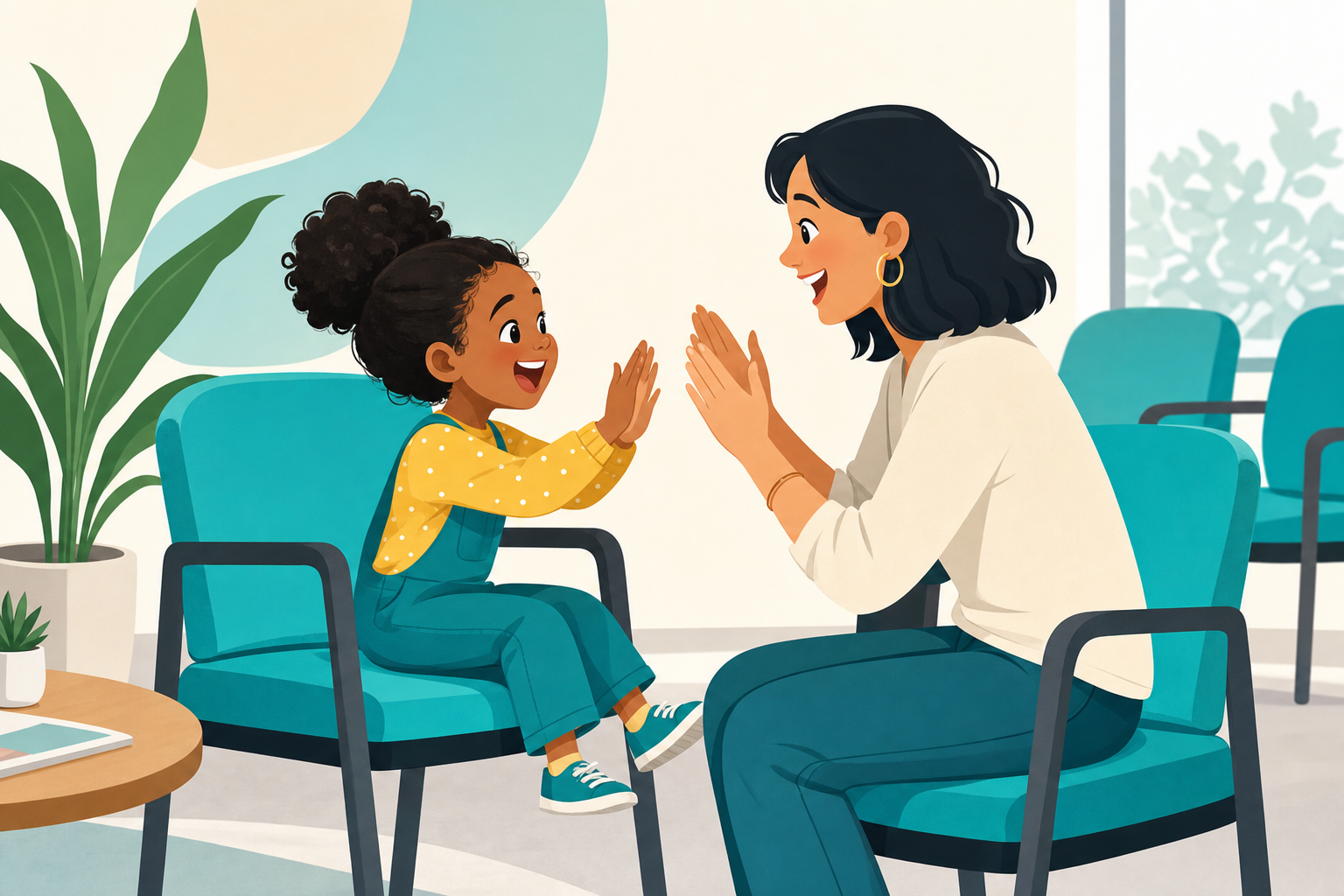
Quiet Clapping Patterns: You clap a rhythm (two fast, one slow), they copy it back. Keep it soft so you're not disrupting the room. Add complexity as they get the hang of it. This works surprisingly well for restaurant waiting game ideas for kids, too, because it's nearly silent and doesn't need a table.
Count by Category: "Let's count how many chairs are in this room. Now let's count how many have arms. How many are blue?" Counting gives toddlers a concrete task and a sense of accomplishment when they reach the end.
Coloring is one reliable boredom buster. A free Chunky Crayon page buys you ten quiet minutes if you happened to throw crayons in your bag, but when you don't have supplies, these voice-and-observation games are your backup plan.
Restaurant Waiting Game Ideas for Kids When You're Stuck at a Table
Restaurants are trickier than doctor's offices because the wait can stretch longer and the space is more chaotic. But the same principles apply: give them a defined task with a clear endpoint.
Menu Math: If your child knows numbers, challenge them to find the most expensive item, the cheapest item, or add up two menu prices. Younger kids can count how many pictures are on the kids' menu or how many items start with the letter P.
Napkin Folding Contest: Fold your napkin into a triangle. Can they make a smaller one? A rectangle? A fan? It's tactile, quiet, and uses materials already on the table.
Utensil Patterns: Arrange a fork, spoon, knife in a pattern. Have your child recreate it or make their own. For toddlers, just sorting silverware by type is enough of a challenge.
Would You Rather: Adapt questions to the setting. "Would you rather eat pizza for every meal or never eat pizza again?" "Would you rather have purple hair or green teeth?" The sillier, the better. It keeps conversation going and heads off the "I'm boooored" whine before it starts.
If you're dealing with a longer meal and need to keep multiple kids calm, the same strategies from screen-free train activities work here: rotation, clear expectations, and a mix of solo and group tasks.
Independent Quiet Play for Ages 2 to 6 Using the Environment
No-mess activities for small spaces come down to one thing: treating the environment like a toy. You're not pulling entertainment out of a bag. You're pointing your child toward what's already there and giving it a purpose.
Floor Tile Counting: "Stand on one tile. Can you hop to another tile without touching the lines? How many tiles are between here and the door?"
Shadow Watching: If there's a window, show them their shadow. Can they make it bigger? Smaller? Wave at it? This is especially good for 2- and 3-year-olds who are still amazed by cause and effect.
Quiet Observation Game: "Let's both stay totally silent for one minute and see how many sounds we can hear. Ready? Go." Afterward, compare notes. This works as a reset when energy is escalating and you need everyone to take a breath.
Story Chains: You start a story with one sentence ("Once there was a dog who loved pancakes"), they add the next sentence, you add another, and so on. It's collaborative, it's creative, and it doesn't need anything but imagination.
These strategies overlap with what works during no-screen hotel room downtime. When you're stuck in a small space with limited supplies, observation and imagination are your best tools.
What to Do When Nothing Is Working
Sometimes the wait is too long, the room is too crowded, or your child is too tired. When classic waiting room activities for toddlers aren't cutting it, try these resets:
Bathroom Break: Even if they don't need to go, a walk to the bathroom and back burns energy and changes the scenery. Wash hands slowly, count tiles on the way, point out exit signs.
Snack as Activity: If you have a snack, don't just hand it over. Make it a game. "Can you eat this cheese stick in exactly ten bites?" "Let's see if you can make this cracker last two whole minutes."
Acknowledge the Hard Part: Sometimes kids just need to hear that waiting is tough. "I know this is taking forever. It's hard to sit still for this long. We're almost done, and then we'll go straight to the playground." Validation buys you goodwill.
Worst-Case Escape Plan: If a meltdown is imminent and the appointment isn't critical, it's okay to leave. Reschedule. Try again another day. You're not failing, you're recognizing your child's limits and adjusting.
The Real Goal: Teaching Patience in Five-Minute Increments
You're not trying to turn your child into a waiting room angel. You're teaching them that boredom isn't an emergency, that they can entertain themselves with limited resources, and that waiting doesn't last forever.
Every time you successfully navigate a waiting room without screens, toys, or tears, you're building their tolerance for discomfort. That skill will serve them in kindergarten, in grocery store lines, and in every future situation where life requires them to just sit tight for a bit.
These quiet no-prep activities for preschoolers and toddlers aren't about perfection. They're about survival. You're doing great.