October 21, 2026
Quiet Kids Activities While You Work From Home
A screen-free 2-hour activity rotation for ages 2 to 10 using household items. No-prep independent play ideas to keep kids busy while you work. Try it today.
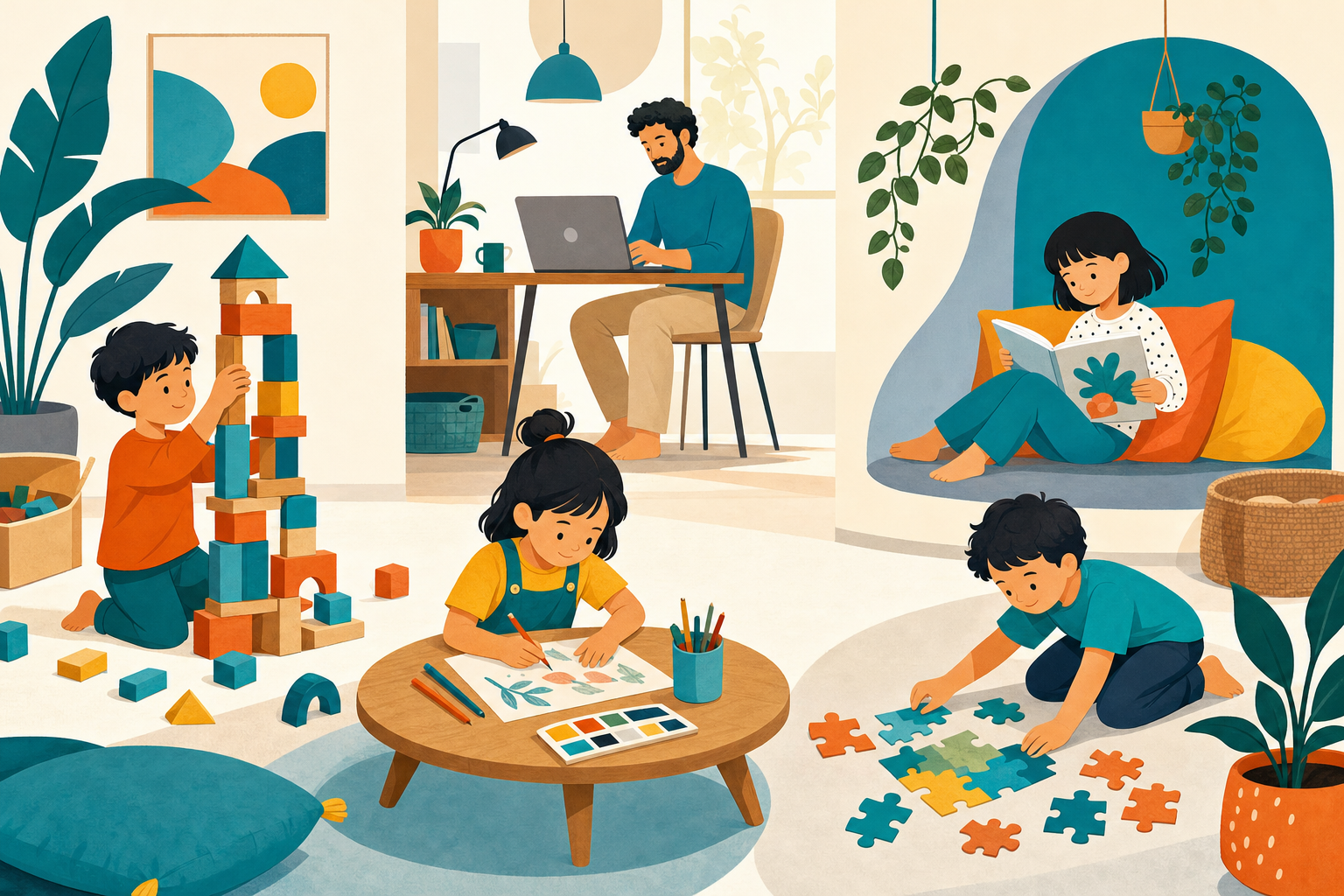
How to Keep Kids Busy Quietly While You Work From Home: A Screen-Free 2-Hour Activity Rotation (Ages 2 to 10)
Your calendar says "focus block." Your house says otherwise. You've got a 2-year-old climbing the bookshelf and a 9-year-old asking if they can watch something "just this once" for the fourth time today.
Most advice online gives you a list of 50 indoor activities and calls it a day. That's not the problem. The problem is sequencing: what keeps a toddler safe and quiet while an older kid stays entertained, without you refereeing every ten minutes. This is a realistic rotation, built around noise level, setup time, and how much of your attention each block actually needs.
Why Generic Activity Lists Don't Work for Work-From-Home Days
A scavenger hunt is a great idea for a Saturday afternoon. It is a terrible idea during a client call because it involves running, yelling, and "Mom, come look!" every 90 seconds.
What actually matters for quiet independent play during work hours is different from what matters on a lazy weekend:
- Noise level: Can this activity happen near a closed office door without you hearing it?
- Setup time: Does it take you 2 minutes or 20 to get going?
- Adult involvement: Does it need you to referee, or can kids run it themselves once started?
- Age spread: Can a 2-year-old and an 8-year-old do versions of this at the same time, in the same room?
Most roundups skip all four. This rotation answers them directly.
The 2-Hour Rotation Framework
Instead of picking one activity and hoping it lasts, break your work block into four 30-minute chunks. Each chunk has a different energy level, so kids don't burn out on one thing and start looking for you.
Block 1 (0 to 30 min): Quiet solo task, low supervision
Good for right after you sit down, when you need silence immediately.
- Ages 2 to 4: A muffin tin with dry pasta, pom-poms, and a spoon for sorting. Add a scoop of rice in a shallow bin for scooping and pouring.
- Ages 5 to 7: A clipboard with paper, a sticker chart gone rogue (just stickers and blank paper for free-form art), or a simple matching game with household objects.
- Ages 8 to 10: A chapter book, a drawing challenge card, or a "build the tallest tower" prompt using only things from one kitchen drawer.
This block needs almost no setup if you keep a dedicated bin ready. Fill it once a week, not once a day.
Block 2 (30 to 60 min): Semi-independent, moderate setup
Energy is still manageable here, but kids may need a 60-second check-in.
- Toddlers: Painter's tape on the floor for a "road," plus toy cars. Ten minutes of your help taping it down, then they're set.
- Preschoolers and early elementary: A pretend restaurant or post office using paper, envelopes, and play money cut from index cards.
- Older kids: A LEGO or craft challenge with a specific goal ("build something that could float") instead of open-ended free play, which tends to fizzle faster.
Block 3 (60 to 90 min): The quietest block, right when your energy (and patience) is lowest
This is prime time for a screen-free activity with household items that requires almost zero noise.
- A coloring page is the easiest lever here. Coloring is one reliable boredom-buster, and a free page from Chunky Crayon buys you fifteen to twenty quiet minutes without any prep on your end.
- Pair it with a "quiet box": a shoebox with playdough, a sketchpad, or sticker sheets that only comes out during this block, so it still feels special after weeks of use.
- For mixed ages, everyone coloring at the same table (even different pages) keeps the noise contained to one room.
Block 4 (90 to 120 min): Movement with boundaries
By now, kids need to move, but you still need quiet-ish. The trick is channeling movement into something contained.
- An obstacle course made from couch cushions and painter's tape, built earlier in the day so setup doesn't eat into work time.
- A "freeze and draw" game: music plays, kids move, music stops, they draw whatever pose they're in. It's active but self-paced and doesn't need you.
- For toddlers, a laundry basket "boat" they can sit in and rock, or a pillow pile for jumping practice nearby (within eyesight, not earshot-dependent).
What to Do When a Meeting Pops Up Mid-Rotation
Some days the rotation gets interrupted by an unscheduled call. Keep one "emergency only" activity in reserve that you don't use otherwise, so it still feels novel when you pull it out. For a step-by-step plan specifically for sudden video calls, this guide on keeping kids quiet during work calls walks through a 30-minute version that slots neatly into any block above.
If you're consistently getting derailed by siblings fighting over supplies, a simple fix is giving each kid their own labeled bin for Block 1 and Block 3 so there's no negotiation about whose pom-poms are whose.
Keeping the Rotation Running Day After Day
The rotation only works long-term if it stays low-prep. Spend 15 minutes on Sunday refilling bins and printing a couple of pages instead of improvising each morning. For a deeper bench of no-prep, no-mess options that fit this same independent-play model, this list of screen-free indoor activities kids can do on their own is a good rotating source of new Block 1 and Block 2 ideas.
Rainy days make this harder since outdoor movement isn't an option for Block 4. On those days, swap the obstacle course for an indoor dance freeze game or a pillow fort building project, both of which burn energy without needing a yard.
If your afternoons also need structure beyond the workday, a flexible weekend routine chart can extend this same block system into non-work hours, so kids already understand the rhythm of quiet time followed by movement time.
The Real Goal: Predictability, Not Perfection
This rotation won't buy you two hours of total silence every single day. Some days Block 3 only lasts ten minutes before someone needs you. That's fine. The goal is a repeatable structure that gets you 70 to 80 percent of a quiet, productive workday instead of zero, and gives your kids a predictable rhythm they can run with mostly on their own.
Start with just Blocks 1 and 3 tomorrow. Two quiet stretches are better than one chaotic afternoon, and once those two blocks are working smoothly, adding the other two gets a lot easier.