June 4, 2026
17 No-Prep Restaurant Activities to Keep Kids Busy
Discover screen-free restaurant games and quiet table activities that keep 3- to 7-year-olds entertained while you wait for food. No meltdowns required!
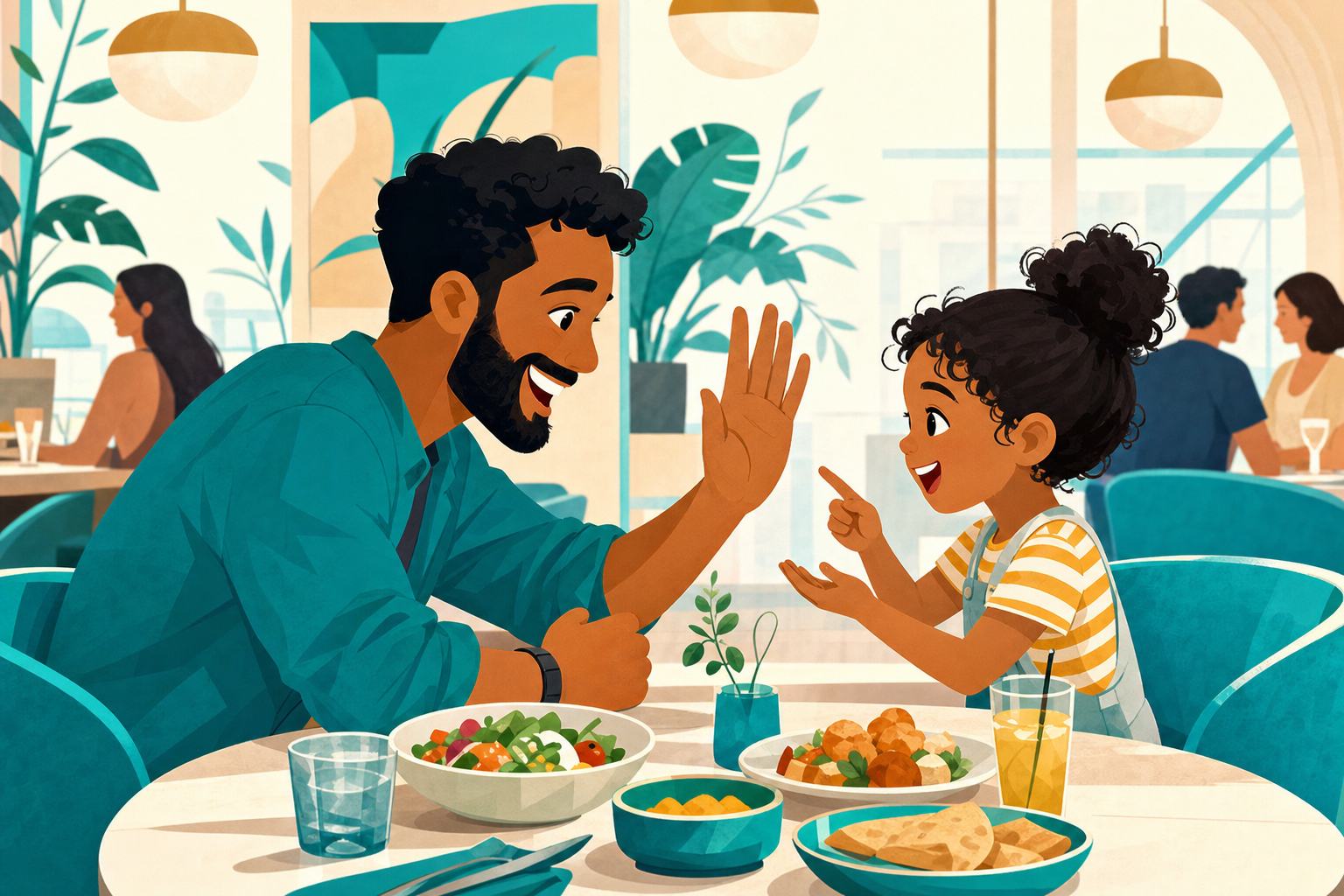
How to Keep a 3- to 7-Year-Old Busy at a Restaurant While You Wait for Food Without Screens, Coloring Pages, or a Meltdown
You just sat down, menus are open, and your kid is already sliding under the table asking when the food's coming. You've got 15 minutes minimum before plates arrive, and you left the crayons at home. Here's how to bridge that gap with zero prep, zero mess, and zero screens.
Why Restaurant Waiting Is So Hard for Little Kids
Restaurants combine every sensory trigger that makes young kids squirm. They have to sit still, keep their voices down, and wait for something they can't see or control. A 4-year-old's sense of time is wildly off, so "ten minutes" feels like an hour.
The good news: you don't need a busy bag for restaurant waiting or a pile of toys. You need four or five reliable verbal games and one physical fidget strategy that works at a table.
Verbal Games That Work at a Table (Ages 3 to 7)
These are quiet, no-mess restaurant activities for kids while waiting that keep hands on the table and voices at inside volume.
I Spy (with a constraint). Classic I Spy works, but add a rule to make it stickier. "I spy something red that someone is wearing." Or "I spy something round that's on our table." The constraint forces closer observation and buys you three extra minutes per round.
Rhyme Chain. You say a word, they say a rhyming word, you go back and forth until someone gets stuck. Start easy: cat, hat, bat, mat. Let them win. A 5-year-old will stay engaged for five to seven rounds if they feel like they're beating you.
Would You Rather (food edition). Tailor it to the restaurant. "Would you rather eat only pizza for a year or only chicken nuggets?" "Would you rather have dessert first or dinner first?" Let them ask you one back. It keeps the conversation reciprocal, and they love getting to stump you.
Guess the Order. Before the server comes back, each person guesses what everyone else ordered. A 6-year-old will remember surprisingly well, and it gives them a job: tracking predictions until plates arrive.
20 Questions (simple version). You think of an animal, they ask yes-or-no questions. Limit it to animals they know from books or the zoo, and let them take a turn being the thinker. It works until about age 7, when they start wanting harder categories.
If you're stuck on more ideas like these, try the same kind of no-equipment verbal games that work in the car at /blog/no-equipment-car-games-kids.
One Quiet Fidget Strategy That Won't Annoy Other Diners
Kids this age need something for their hands. Here's the lowest-mess option that works in a booth or at a table.
Napkin folding challenge. Hand them two paper napkins and show them how to fold a simple triangle, then a smaller triangle, then a tiny one. See how small they can go. Then try a fan fold. Then a roll. It's screen-free restaurant entertainment for toddlers and preschoolers that feels like a task, not a time-killer.
If they're done in two minutes, add a rule: fold the napkin using only one hand. Or fold it behind their back (this will make them giggle, but it's quiet giggling).
Coloring is one reliable boredom-buster when you're really stuck, and a free Chunky Crayon page buys you ten quiet minutes if you have a phone and a pencil in your bag.
Independent Restaurant Activities for Young Kids (When You Need to Talk to Another Adult)
Sometimes you're at a restaurant because you're trying to have a conversation with your partner, another parent, or a friend. You need quiet table activities for kids that don't require you to referee every 90 seconds.
Silverware sorting. If there's a caddy of silverware on the table, let them sort forks, spoons, and knives into three piles. A 3-year-old will do this happily for four minutes. A 5-year-old will invent a pattern (fork, spoon, fork, spoon) and stick to it.
Sugar packet stacking. If there's a bowl of sugar packets, sweetener packets, or creamers, they can stack them. See how high they can go before the tower falls. It's independent, it's quiet, and you can nod along while they narrate.
Menu scavenger hunt. Give them the kids' menu or a regular menu and ask them to find three foods that start with the letter B, or three foods that are red, or three things they've never tried. A 6-year-old will take this seriously. A 4-year-old will need you to read, but they'll point and guess.
These are the same principles that work for other tight-space waiting games, like the ones in /blog/laundromat-activities-for-kids-screen-free or /blog/ferry-activities-for-kids-screen-free, just adapted for a table.
What to Do in the Last Five Minutes Before Food Arrives (When They're Done with Everything)
You've burned through I Spy, napkin folding, and silverware sorting. The food is almost here, but your kid is starting to melt. Here's the bridge.
Guess what's in the kitchen. Ask them to close their eyes and guess what the kitchen smells like right now. Garlic? Fries? Bread? It's a sensory redirect that takes 30 seconds and resets their brain.
Hand clapping patterns. You clap a simple rhythm (clap, clap, pause, clap). They repeat it. Then they make one up, and you repeat it. It's a quiet physical game that works in a booth and doesn't involve standing or yelling.
Silent staring contest. This is a last resort, but it works. You stare at each other without blinking or smiling. First person to crack loses. A 5-year-old will last 10 to 15 seconds, but they'll want a rematch, and that buys you two more minutes.
If you're in full meltdown territory and nothing is landing, the same tricks that work during witching hour at home apply here: redirect to a physical task, name the feeling, and ride it out.
The One Thing to Bring Next Time (If You Want Insurance)
If you know you're going to a sit-down restaurant and you want one no-prep backup plan, bring a small notebook and a pencil. Not for coloring. For games.
Tic-tac-toe tournament. Play best of five. Let them be X every time.
Dots and boxes. Draw a grid of dots (start with 4x4 for a 5-year-old, 6x6 for a 7-year-old). Take turns connecting two dots with a line. When you complete a box, you initial it. Most boxes wins.
Draw a silly face. You draw the head. They add eyes. You add a nose. They add a mouth. Keep going until it's ridiculous. This works for 3-year-olds who can't play tic-tac-toe yet.
A notebook is lighter than a busy bag, doesn't require batteries, and fits in any purse or diaper bag.
When to Just Let Them Be Bored for a Minute
Sometimes the best thing you can do is let them sit with the feeling of waiting. If they're whining but not melting down, and you've already played two games, it's okay to say, "We're just going to sit quietly for a minute while we wait."
Boredom isn't an emergency. A 6-year-old can handle 90 seconds of doing nothing, and it's good practice for every other public space they'll sit in for the next decade.
If they're struggling with transitions like this in other parts of the day, a simple visual routine chart (like the ones in /blog/after-school-routine-chart-kids-backpack) can help them understand what "waiting" looks like as part of a sequence.
The Real Goal: Get Through 15 Minutes Without a Scene
You're not trying to entertain them for an hour. You're trying to bridge the gap between sitting down and the first plate hitting the table. That's it.
Pick two or three no-prep restaurant games for kids from this list, rotate them, and keep your expectations realistic. A 4-year-old who stays seated, keeps their voice down, and waits without throwing a fork is winning. So are you.