October 26, 2026
Keep Kids Busy Screen-Free While You Work From Home
Try this 2-hour indoor activity rotation for ages 2 to 10. No-prep, low-mess ideas for independent play while you work. Get the free guide now.
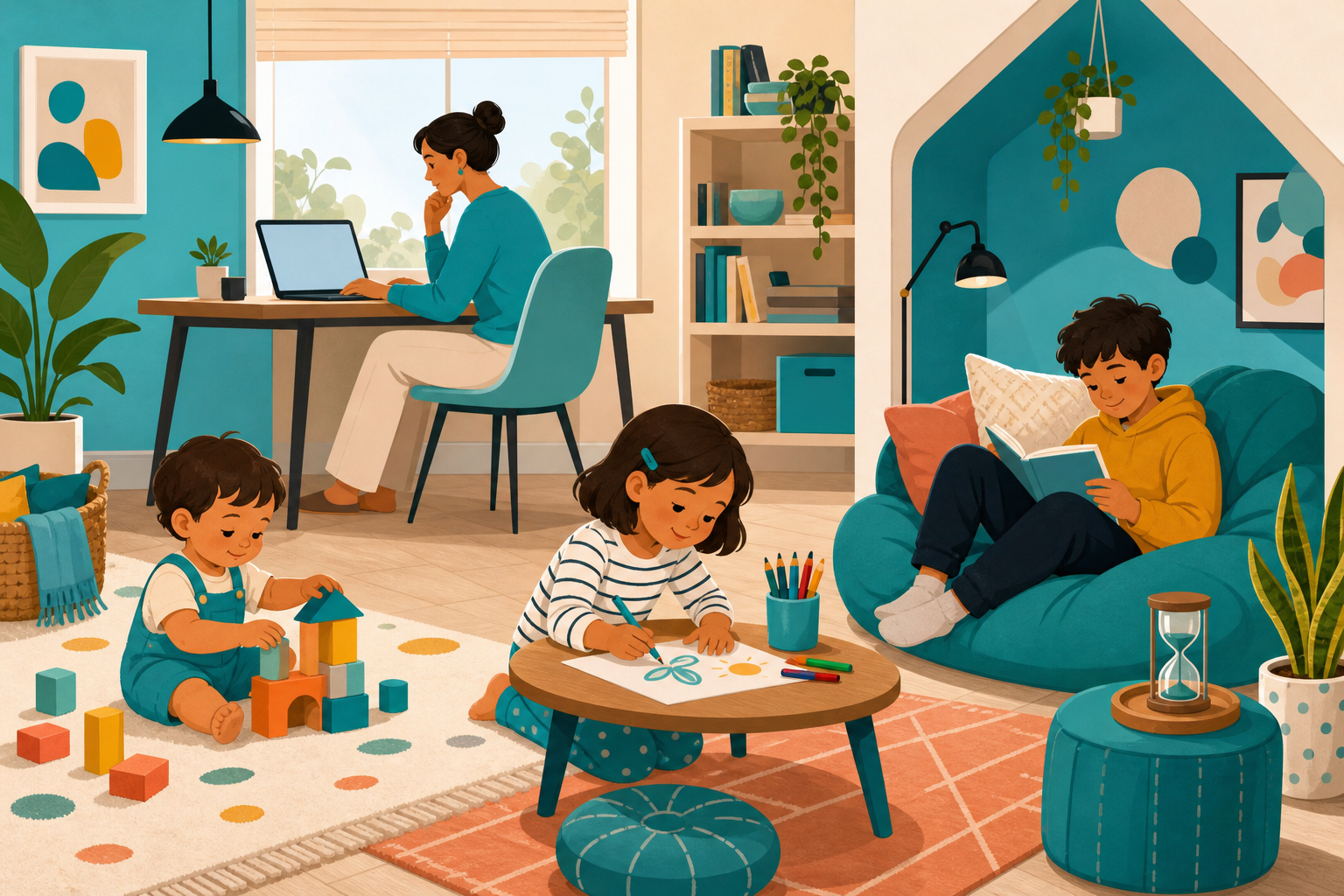
The Problem With "Just Keep Them Busy" Advice
You've read the lists. Build a fort. Do a scavenger hunt. Make a boredom jar. They're fine ideas, but none of them tell you what to do at 9:47 a.m. when you're two minutes into a client call and your 6-year-old is standing in the doorway asking where the glue stick is.
What working-from-home parents actually need isn't more activity ideas. It's a system: a realistic rotation that covers a full work block, matches what your kid can handle at their age, and has a built-in plan for when they interrupt you anyway. That's what this is.
Set Up the Rotation Before Your First Meeting
The whole system falls apart if you're improvising at 8:55 a.m. Spend 15 minutes on a Sunday night getting this ready instead.
Build 4 to 5 activity bins. Shoeboxes, bins, even grocery bags work. Each one holds everything needed for one activity, no extra steps required. A bin with paper, crayons, and stickers beats a cabinet your kid has to dig through.
Label them by energy level, not by activity type. One bin for quiet solo play, one for low-mess creative work, one for movement, one for "parent-adjacent" play they can do near your desk without touching your keyboard. This matters more than the specific toys inside.
Pre-decide the order. Kids under 7 do better when you tell them "bin one, then bin two" rather than letting them choose from everything at once. Too many options is its own kind of overwhelming, which is also why visual routines work so well for transitions in general; if your child shuts down when plans change mid-task, a printable visual schedule for unexpected changes pairs well with this rotation.
The 2-Hour Rotation, Block by Block
Here's a realistic breakdown. Adjust the minutes to your kid's actual attention span, not the one you wish they had.
Ages 2 to 4 (shorter blocks, more parent check-ins)
- 0 to 20 min: Sensory bin (dry rice, pasta, scoops and cups) at the kitchen table where you can glance over
- 20 to 35 min: Quiet activities for young children like stacking cups, shape sorters, or board books on a mat near your door
- 35 to 50 min: Movement break, a pillow pile to jump on or a laundry basket "boat"
- 50 to 70 min: Parent check-in, snack, bathroom
- 70 to 110 min: Repeat sensory or quiet bin with a fresh item swapped in
- 110 to 120 min: Wind down, you're available again
Ages 5 to 7 (longer independent stretches)
- 0 to 30 min: Drawing, coloring, or a simple craft bin they can start themselves
- 30 to 50 min: Imaginative play, dolls, action figures, a pretend kitchen
- 50 to 60 min: Check-in and snack
- 60 to 90 min: Building (blocks, magnetic tiles, a puzzle)
- 90 to 120 min: Workbook pages, mazes, or a sticker activity book
Ages 8 to 10 (full independence, you're the backup, not the director)
- 0 to 45 min: Self-directed project, Lego build, a drawing challenge, a chapter book
- 45 to 60 min: Check-in
- 60 to 100 min: A "job" that feels grown-up, organizing their desk, writing a letter, a recipe card to copy
- 100 to 120 min: Free choice from any bin
If you have kids at multiple ages, run blocks in parallel rather than trying to sync them. Older kids can often supervise a younger sibling's bin swap for five minutes in exchange for screen time later, which also overlaps nicely with sibling cooperation systems like a printable reward chart for siblings who fight, since taking turns helping each other is its own kind of chore.
The Interruption Rule
This is the part most advice skips entirely, and it's the part that actually saves your meetings.
Give your kid three signal words tied to a simple chart or colored card on your desk:
- Green card = ask me anything, I'll answer in a sentence.
- Yellow card = write it down or whisper it, I'll handle it at the next break.
- Red card = emergency only (blood, fire, a sibling crying hard).
Teach this before your first call of the day, not during it. Practice it once with a pretend meeting so they know what yellow actually feels like. Most 5-year-olds can hold a yellow-level question for 15 minutes if they know a break is coming and you follow through every single time.
Activities Kids Can Start Themselves
The real goal is independent play for kids while a parent works, which means every bin needs a built-in way to begin without you. No-prep indoor activities for ages 2 to 10 that pass the "can they start alone" test:
- A tray of dry pasta, a spoon, and empty jars (ages 2 to 5)
- A basket of fabric scraps and safety scissors for "fashion design" (ages 5 to 8)
- A deck of cards for solo games like War solitaire or building card houses (ages 6 to 10)
- Painter's tape on the floor for a balance-beam path (any age, big movement release)
- A clipboard with a scavenger hunt list they check off themselves
- A coloring page and a cup of crayons, which doubles as a low-mess indoor boredom buster that also works for rainy-day activities without screens when the weather kills your outdoor backup plan
Speaking of coloring, it's one of the most reliable options because there's zero setup and almost zero mess. A free Chunky Crayon page can buy you ten genuinely quiet minutes, which is often exactly the gap between two meetings.
When It Falls Apart
Some days the rotation just doesn't hold, and that's normal, not a sign you did it wrong. Keep one "break glass in case of meltdown" bin stocked separately from the rotation, something new and a little exciting they haven't seen this week. Save it for the day your 4-year-old refuses every bin by 9:15 a.m.
And if independent play keeps collapsing no matter what you try, it's worth troubleshooting the pattern itself rather than the activities. A deeper look at screen-free independent play ideas can help you figure out whether the issue is the activities, the timing, or the transitions between them.
The goal was never a perfect two hours. It's enough quiet, independent stretches that you get through your work, and enough check-ins that your kid doesn't feel forgotten. That's a realistic win on a Tuesday.