October 4, 2026
Screen-Free Sibling Activities to Survive Your Workday
A realistic 90-minute activity rotation for kids ages 2 to 10. No-prep, low-supervision ideas to keep siblings busy while you work from home.
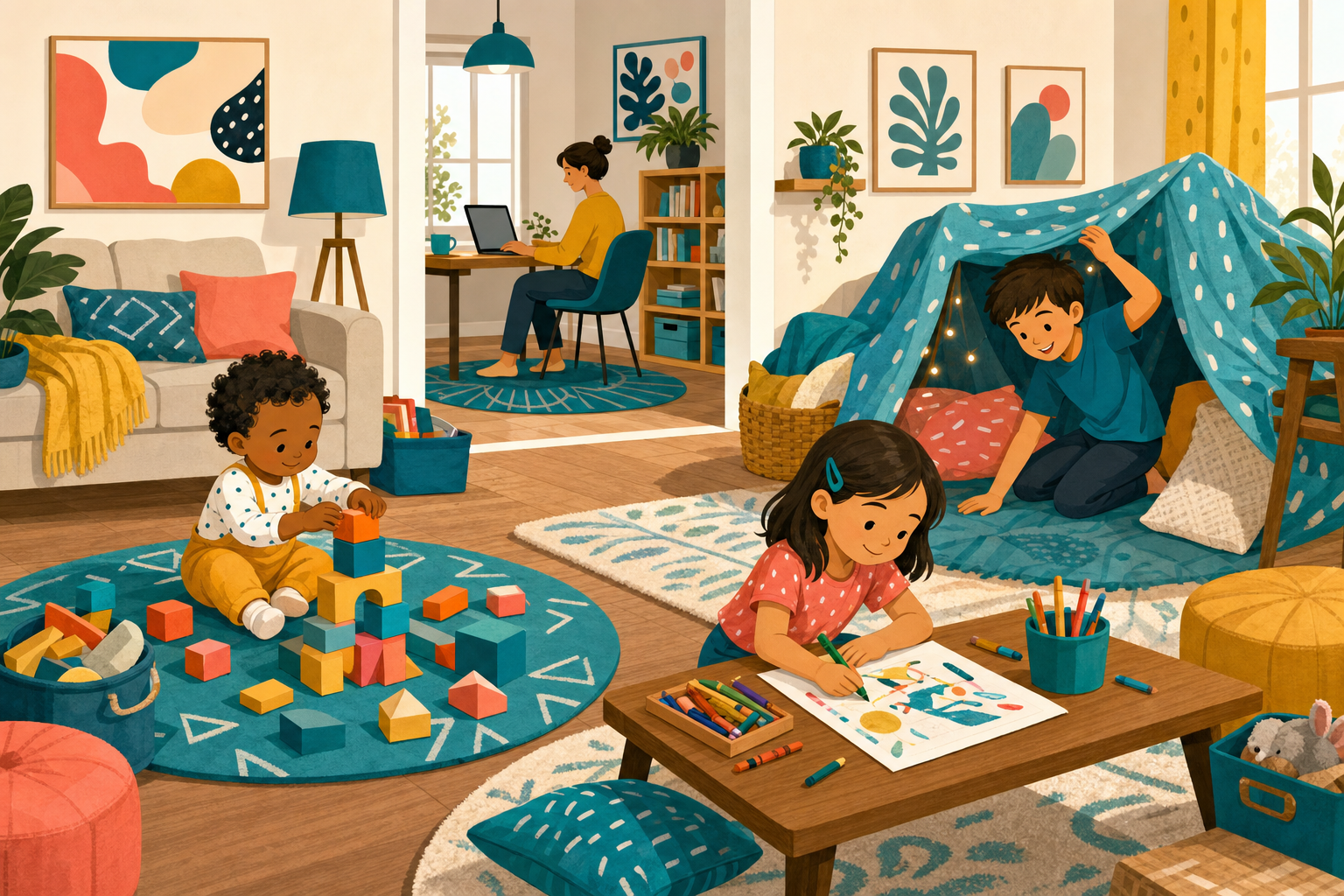
How to Keep Siblings Busy Indoors Without Screens While You Work From Home: A Realistic 90-Minute Rotation (Ages 2-10)
You have a 90-minute block of meetings, the baby monitor is quiet, and two kids who are already circling each other like they're bored of each other before 9am. You don't need another list of 50 activities. You need a plan that actually survives contact with a 2-year-old and a 10-year-old sharing the same living room.
Most advice online gives you a pile of ideas and leaves you to figure out the sequencing, the supervision level, and what to do when one kid finishes in four minutes and the other wants to go for an hour. Here's a rotation that actually accounts for all of that.
Why Generic Activity Lists Fall Apart During Work Hours
A list of 20 fun things to do is not a plan. It doesn't tell you which activities need you nearby, which ones you can walk away from completely, or how to stop your 10-year-old from "helping" your 2-year-old right when you need five uninterrupted minutes to talk on a call.
The real problems parents hit during work-from-home days are specific:
- One kid finishes an activity in 90 seconds and starts bugging the other
- The toddler needs more hands-on supervision than the plan assumes
- Both kids want you at the exact same moment
- Nobody warns you when quiet time is about to end, so it ends badly
A working rotation solves for all four. That's the gap most "rainy day activity" posts never touch.
The 90-Minute Rotation, Block by Block
Split your 90 minutes into three 30-minute blocks. Each block has a different noise and supervision level so you can match it to what your work actually requires at that moment.
Block 1 (0 to 30 min): Independent Quiet Play
This is for when you have a call or need deep focus. Set both kids up separately, in the same room if possible so you can glance over.
- Toddler (ages 2-3): a bin of dry pasta or rice with scoops and cups, a sticker sheet, or a busy book
- Older kid (ages 6-10): a workbook, a Lego set they already know, or a quiet, no-prep activity set that doesn't need supervision
Set a visible timer. Kids who can see when quiet time ends are far less likely to interrupt in the middle.
Block 2 (30 to 60 min): Parallel Active Play
This block absorbs energy without needing full attention from you. Think movement that doesn't require a referee.
- An obstacle course made from couch cushions and painter's tape on the floor
- A "museum" where the older kid curates toys and the younger one is the visitor
- Indoor scavenger hunt with a list the older sibling reads aloud to the younger one
This is also the block where you can step away for 10 to 15 minutes at a time, because the activity has built-in momentum.
Block 3 (60 to 90 min): Together Time, Low Supervision
By now, energy and patience are both running low. This block works best when siblings are doing something together that doesn't need a referee, just an occasional check-in.
- Building a fort together with a flashlight for a "campout"
- A simple board game the older kid can run mostly solo
- Free play with a shared bin of blocks or figures
If you've been looking for a structure that actually stops the bickering instead of just distracting from it, this is similar in spirit to the approach in this no-prep sibling activity guide, which breaks activities down by how much referee-ing they realistically require.
Setting Supervision Boundaries So You're Not Interrupted Every 5 Minutes
The biggest reason rotations fail isn't the activities. It's that kids haven't been told, clearly, what "I'm working" actually means in practice.
Before block 1 starts, set a simple rule out loud: "I can hear you if something is broken, bleeding, or an emergency. Everything else waits until the timer goes off." Write it on a sticky note near the play area for the kids who can read.
For younger kids who interrupt out of habit rather than true need, a visual cue works better than repeating yourself. A closed door, headphones on, or a colored card system (green means ask, red means wait) all do the job without you having to explain it 40 times a day. If interrupting is a recurring issue outside of work blocks too, a reward-based approach to reducing interruptions can reinforce the same waiting skill you're trying to build during your workday.
Keeping Mixed-Age Siblings From Competing for Your Attention
This is the part most lists skip entirely. When a 2-year-old and an 8-year-old are both bored at the same time, they don't compete with each other first, they compete for you.
A few things actually reduce this:
- Stagger the start times. Get the older kid settled into something for five minutes before you set up the toddler. A head start means less "I was here first" friction.
- Give the older sibling a job, not a babysitting role. "You're in charge of reading the scavenger hunt list" feels different to a kid than "watch your brother." One is a task, the other is pressure they didn't ask for.
- Rotate who gets the first choice of activity. Alternating this daily removes a surprising amount of arguing before it even starts.
- Keep one "pocket activity" in reserve. When one kid finishes early and the other is still going, you need a two-minute activity (a sticker page, a coloring page) ready to go so nobody's idle hands start poking the other sibling.
Speaking of coloring, it's one of the most reliable boredom-busters precisely because it needs almost no setup. A free Chunky Crayon page printed ahead of time can buy you ten quiet minutes exactly when a block is running short.
When the Plan Falls Apart Anyway
It will, at least some days. Have a two-minute reset ready instead of trying to force the original plan back on track.
- Separate the kids physically for five minutes, even just different corners of the same room
- Offer a snack break as a natural transition point between blocks
- Swap one activity for its backup version instead of abandoning the whole rotation
The goal isn't a perfect 90 minutes. It's a structure loose enough to bend without breaking, so you get through your work block and the kids get through their boredom without anyone needing a screen to survive the morning.