October 11, 2026
Stop Sibling Fights: 60-Min Screen-Free Rainy Day Plan
No-prep indoor activities for siblings ages 2 to 10 that stop fighting, skip screens, and keep everyone happy. Try this 60-minute plan today.
How to Keep Siblings of Different Ages Busy Indoors Without Fighting (A 60-Minute Rainy Day Plan)
It's been raining for three hours, your 9-year-old is bored out of her mind, your 4-year-old wants to be included in everything she does, and somebody just got shoved over a board game. You don't need another generic list of "20 rainy day crafts." You need a plan that actually accounts for the fact that your kids are not the same age and do not play the same way.
Most advice treats siblings like a matched set. Real siblings aren't. A 2-year-old wants to dump things out. A 10-year-old wants a challenge with actual rules. Put them in the same activity with no structure and you get chaos, not bonding. Here's a 60-minute plan built around that reality, not around it.
Why "Just Play Together" Backfires
When you tell mixed-age siblings to "go play," you're asking a 7-year-old to either dumb down their play or dominate it, and asking a 3-year-old to either get bored or get run over. Neither kid actually wants that. The fighting usually isn't about the toy. It's about one kid feeling babied and the other feeling left out.
The fix isn't finding one activity every age loves equally. It's rotating between three activity types so each kid gets a turn being the "expert" and a turn getting help. That's the whole secret behind good independent sibling play ideas: nobody is stuck in the same role the entire time.
The 60-Minute Plan, Block by Block
Break the hour into four 15-minute chunks. Set a timer your kids can see or hear (a kitchen timer works great, phones invite screen requests). The timer does the nagging so you don't have to.
Minutes 0 to 15: Parallel Independent Play
Each kid gets their own low-prep activity, same room, no sharing required. This is the easiest block because nobody has to negotiate anything.
- Toddler (2-3): a bin of dry pasta and measuring cups, or a basket of socks to "sort" by color
- Preschooler (4-6): stickers and paper, or a pretend grocery store with pantry cans
- Big kid (7-10): a LEGO challenge card ("build something that floats") or a maze book
This block fails if you try to make them share one activity. Don't. Separate and parallel is the goal here, not together.
Minutes 15 to 30: One Shared, Low-Prep Cooperative Game
Now bring them together for something with a shared goal instead of a shared toy. Low-prep cooperative games for kids work because everyone is on the same team against the game, not against each other.
- Build the tallest tower using only couch cushions and books before the timer runs out
- "Indoor scavenger hunt" where the big kid reads clues and the little one carries the basket
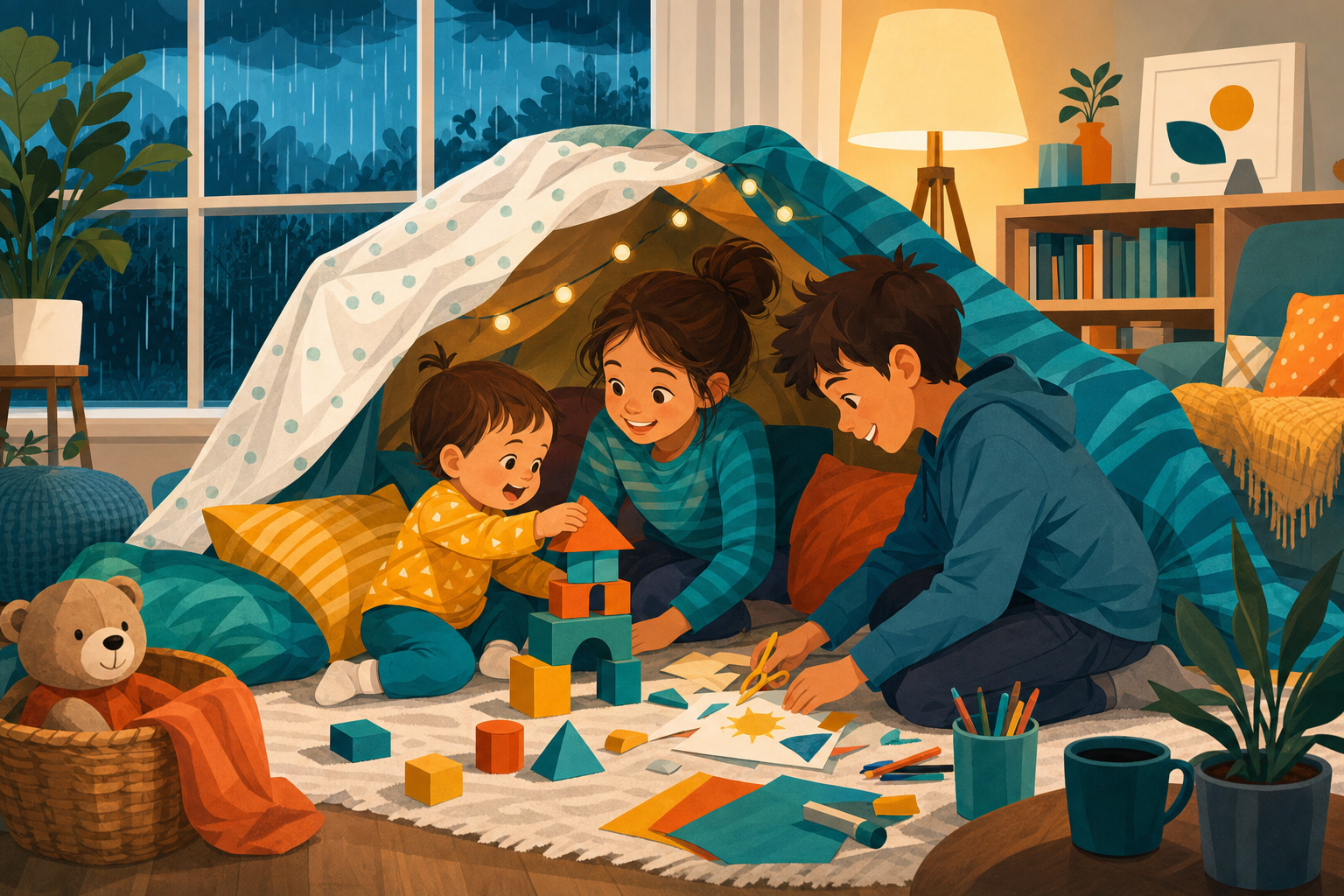
- A pillow fort with assigned jobs: one holds blankets, one finds clips, one tests if it collapses
Give the oldest kid a real job (reader, timer-holder, judge) instead of just "helper." That one tweak solves half of how to stop siblings fighting indoors, because the older kid stops feeling like a babysitter.
Minutes 30 to 45: Role-Based Pretend Play
Pretend play works across ages if you assign roles instead of leaving it open-ended. Open-ended pretend play with a 3-year-old and an 8-year-old usually collapses because their imaginations are moving at different speeds.
- Restaurant: big kid is chef and writes the menu, little kid is customer and orders by pointing
- Vet clinic: stuffed animals as patients, big kid does "checkups," little kid holds the animal still
- Mail carrier: big kid writes notes, little kid delivers them to rooms in the house
Minutes 45 to 60: Quiet Wind-Down Together
Energy is usually peaking or crashing by now, so bring it down with something calm and side-by-side. This is also where you buy yourself a genuinely quiet ten minutes. Coloring is one reliable boredom-buster here, and a free Chunky Crayon page gives each kid their own custom picture to work on without any prep from you.
Age-Specific Adjustments That Actually Matter
A plan built for "kids" instead of "your specific kids" will fall apart by minute 20. Adjust based on who you actually have in the room.
- Ages 2-3: Keep their job physical, not verbal. "Carry the basket" beats "keep score." Expect them to wander off after 8 to 10 minutes and that's fine, let them rejoin the next block.
- Ages 4-6: They want rules but also want to win. Build in a way for everyone to "win" (first to finish, best decorator, loudest cheer) so there's no real loser.
- Ages 7-10: They need a job with actual responsibility, not busywork. Letting them run the scavenger hunt clues or referee the tower game keeps them engaged instead of resentful.
If your age gap is wide (say a 2-year-old and a 10-year-old), lean harder on the parallel play blocks and shorten the shared blocks to 10 minutes instead of 15. Wide gaps need more separate time and shorter togetherness, not less.
The One Rule That Stops Most Sibling Fights
Before you start, say this out loud: "Nobody touches what someone else is building or holding without asking first." That single sentence prevents the most common flashpoint in screen-free sibling activities indoors, which is one kid grabbing or knocking over what another kid made.
Post it somewhere visible if your kids respond better to seeing rules than hearing them. If turn-taking is a recurring issue beyond this one afternoon, a sticker chart built around sharing and turns can reinforce the habit outside of rainy-day mode too.
Realistic Expectations (So You Don't Feel Like You Failed)
This plan will not run perfectly. Someone will get frustrated around minute 35. That's normal, not a sign you did it wrong. If a full meltdown happens mid-plan, pause the timer, let the upset kid have two minutes alone, then restart the current block instead of scrapping the whole hour.
If today is more about damage control than a full structured hour, a faster 30-minute reset for bored, fighting siblings can get you through the rough patch before trying the longer plan again later.
Keep a Rotation Ready for Next Time
The real win here isn't one good hour, it's having a repeatable system for rainy day activities for mixed ages so you're not improvising from zero every time the weather turns. Keep a short list on the fridge of two or three options per block so you can swap them in without replanning. For more no-prep activities for siblings to rotate into your own version of this plan, this collection of screen-free ideas for ages 2 to 10 is a solid backup bank for next time it rains.